Keto worked for someone you know and did nothing for you. Low-carb worked until it didn't. Every framework you've tried was built for an average person who isn't you, and the real variable, calories relative to your body, your goal, your protein needs, was never part of the plan. This is the calculation that replaces the guessing: one formula, five personalized numbers, no forbidden foods.
Let me guess what your history with nutrition actually looks like.
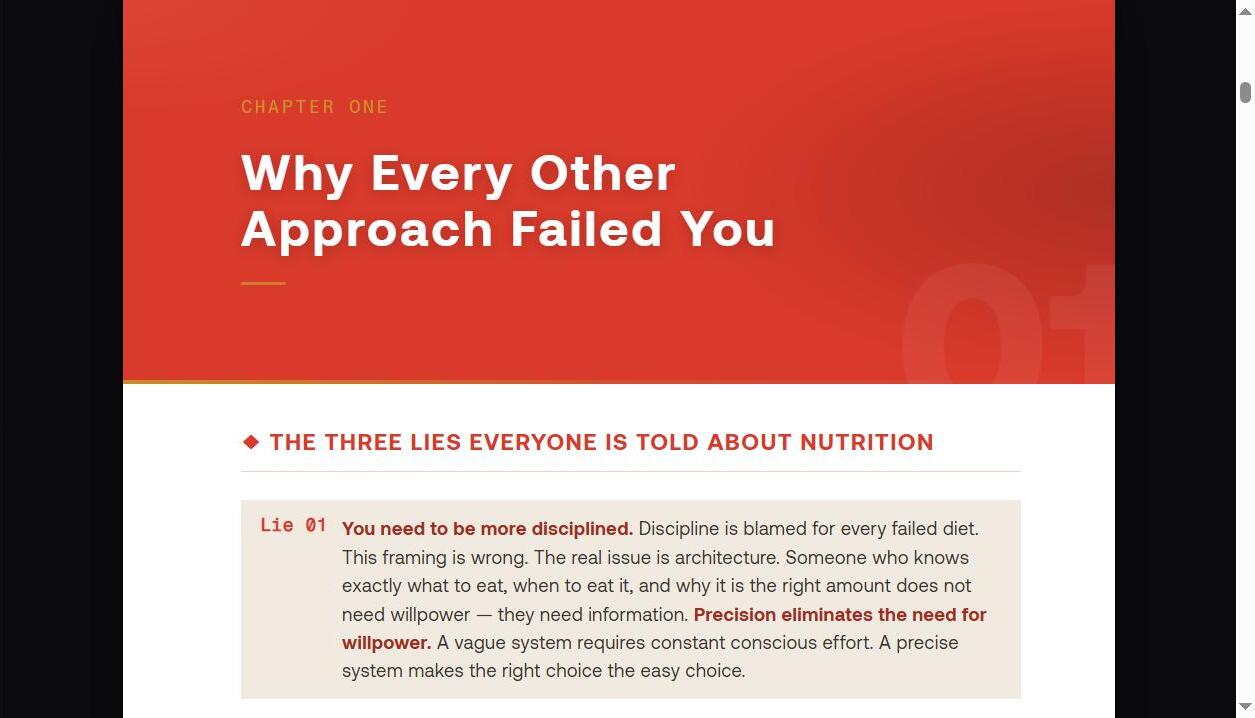
You've been told, at some point, that you just need more discipline. That some foods are bad and some are clean. That the framework failed because you didn't follow it hard enough, not because the framework itself was never built for you. All three of those are lies, and believing them is why the same cycle keeps repeating: strict for a few weeks, one "bad" meal, the guilt that follows it, and the slow abandonment that turns one dinner into a lost month.
A vague system requires constant conscious effort. A precise system makes the right choice the easy choice. That's the actual difference between someone who eats well without thinking about it and someone white-knuckling their way through another Monday reset, and it has nothing to do with willpower. Food moralizing, "clean" versus "dirty," is the direct driver of that binge-restrict cycle: label a food bad, eat it anyway, and you've turned dinner into a moral failure instead of a Tuesday. And no single framework, keto, low-carb, high-carb, is universally correct, because none of them address the actual governing variable: total calories relative to what your body burns, combined with whether you're eating enough protein. Someone eating 2,800 calories on a strict keto plan will not lose fat if their body only needs 2,500. Someone eating 2,000 calories of carbs will, if that's below what they burn.
Here's the part that actually matters, if you'll let me say it plainly: you don't need another diet. You need your own numbers, calculated from your own bodyweight and your own goal, so that every food decision has something real to check itself against.
This isn't a meal plan and it isn't another diet philosophy. It's a five-step calculation that turns your bodyweight and your goal into five personal numbers, and a system for hitting them without living on a spreadsheet. Keep reading. The next section shows you what's actually inside.
Not another meal plan telling you what to eat at 7am on a Tuesday. One calculation system, where every piece tells you what your body actually needs and why.
Most sales pages describe a book in adjectives. Here's the actual table of contents.
$29. Every chapter above, included.
I want my five numbers, not another diet, $29Be honest, you've downloaded a "macro guide" before. You know exactly how that story ends: generic numbers that weren't built for your bodyweight, no way to recalculate as you change, closed by week two. We built this one specifically so that doesn't happen to you again.
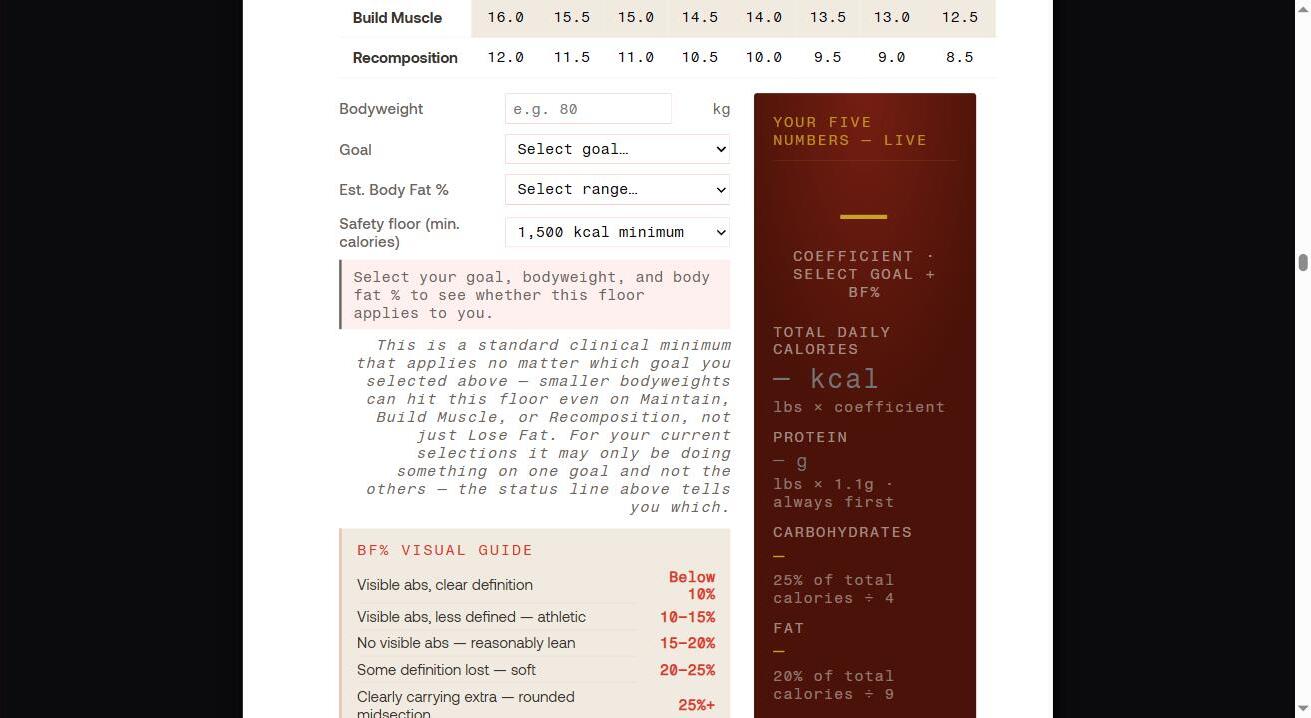
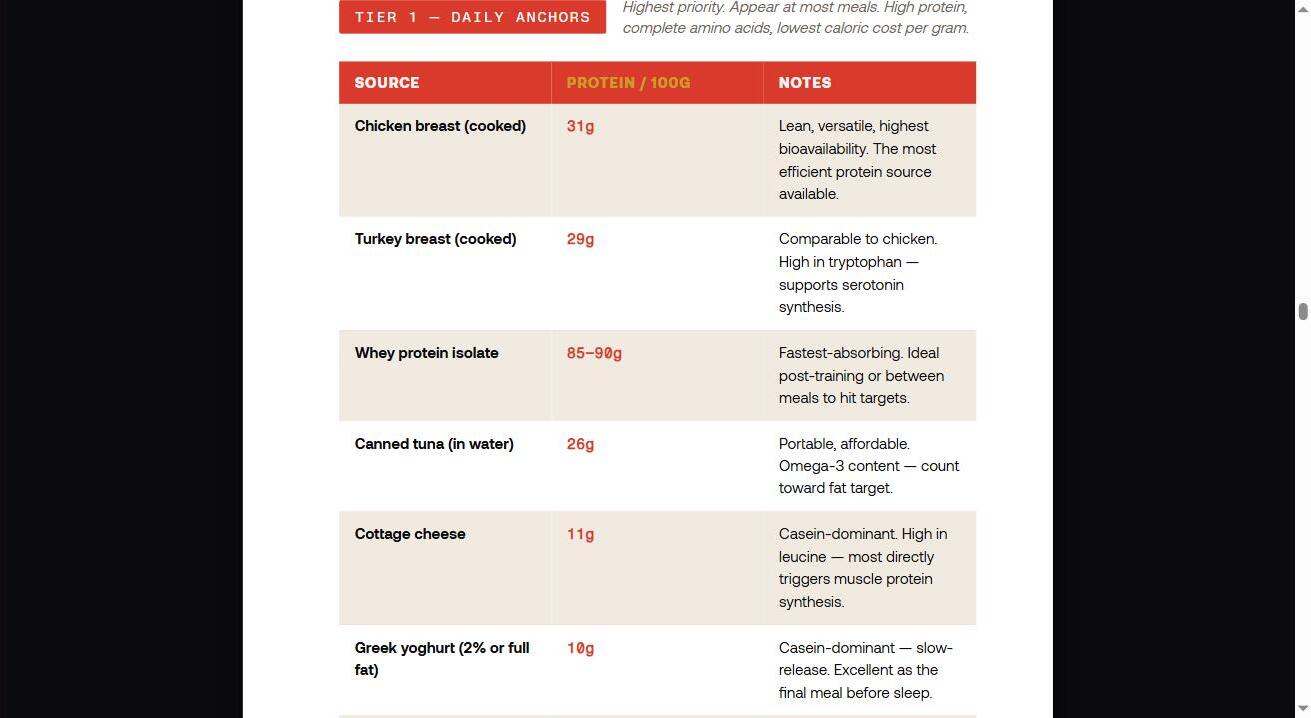
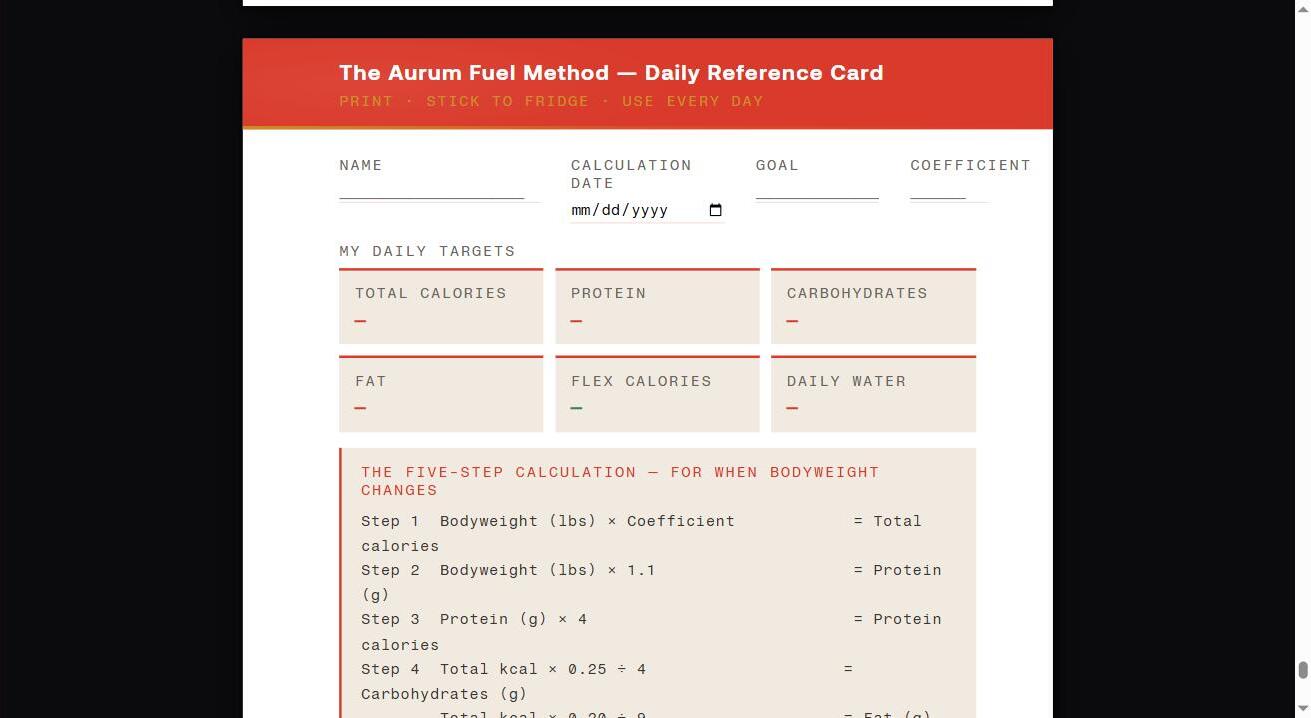
This is what actually opens after checkout, not a mockup: the real sidebar, chapter navigation, and calculator.
Not renders, not stock mockups: these are screenshots of the real product, exactly as it looks on your screen.


Actual screenshots from the interactive guide: this is exactly what you'll see.
Every recommendation in this method traces back to the same five numbers, not a generic macro split built for a reader who isn't you.
One coefficient, starting at your maintenance level, adjusted twice: once for your body fat band, once for your goal. Multiply by your bodyweight and your daily calorie target is set.
Calculated before any other number, and never reduced regardless of goal or circumstance. Every other target can slip on a hard day. This one doesn't.
Protein synthesis has a real per-meal dose range where it's maximally stimulated. Four meals sized to that range produces four separate stimulations across the day, which one large dose can't.
Once calories, protein, carbs, and fat are set, whatever remains is yours to spend however you choose. No food is off-limits, because moralizing food is what drives the binge-restrict cycle in the first place.
"A vague system requires constant conscious effort. A precise system makes the right choice the easy choice." Someone who knows exactly what to eat, when, and why doesn't need willpower. They need information.
Labeling a food "bad" turns eating it into a moral failure, which generates the shame that turns one meal into a three-day abandonment. This method has no forbidden foods, only a flex calorie budget spent as you choose.
Keto, low-carb, high-carb, none are universally correct because they ignore the governing variable: total calories relative to what your body burns, combined with whether you're eating enough protein.
Every other target in this method can flex on a hard day. Protein is the one exception, by design, because it's the number with the biggest downstream effect on how the rest of the plan actually performs.
Not adjectives we wrote about ourselves. Real reactions from people who audited their own shelf against the framework.
"I'd done keto for eight months, then low-carb, then a high-carb 'reverse diet' someone in a Facebook group swore by. Chapter 3 was the first place anyone explained why none of them worked the same way twice: it was never the carbs, it was always the calories relative to what my body actually burns."
"I used to have a mental list of 'bad' foods, and eating one of them on a Tuesday usually meant the whole week was shot. The flex budget changed that completely. Nothing is off-limits anymore, it's just numbers, and the guilt spiral just stopped happening."
"I always knew my protein number, I just never hit it. Splitting it across four meals sized the way the guide lays out is the first time it's actually felt achievable instead of a number I'd give up on by 3pm and try to make up for at dinner."
"I printed the Reference Card the day I finished Chapter 4 and it's been on my fridge since. I don't track anything anymore, I just know my four numbers and eat toward them. That's the part no app ever gave me, a system I didn't have to keep opening."
Five numbers, one calculation, no forbidden foods.
I want to eat like a person who knows their own numbers, $29Ten chapters. The live Calorie Coefficient Matrix. The full Protein System and Four-Meal Framework. The printable Reference Card. Add up what that's worth to you, then look at the number below it.
Open it, run your own numbers through the calculator, read as much or as little as you want. If you don't think it's worth more than $29 within 14 days, email us and we'll refund you in full. Just tell us it wasn't worth it and we'll process the refund the same day. We built this to be used, and that means the risk sits with us, not you.
Here are the honest answers to what's probably still on your mind.
Because those are frameworks and this is a calculation. Chapter 3 walks through exactly why keto, low-carb, and high-carb approaches all fail the same way: none of them account for the governing variable, your total calories relative to what your body actually burns. This method calculates your five numbers from your own bodyweight and goal, not from a macronutrient ratio that worked for somebody else.
Be honest with yourself here. This method is not appropriate for anyone currently pregnant or breastfeeding, anyone with a current or past eating disorder, or anyone managing a medical condition that requires clinical nutrition supervision. If tracking has ever made your relationship with food worse, this isn't the right tool, a conversation with a professional is.
No. Chapter 1 is explicit that this method has no forbidden foods. Once your calories, protein, carbs, and fat are set, whatever's left is your flex budget, spent however you choose. The method controls the total, not the menu.
No. The calculator is built into the guide itself, and the guidance in Chapter 4 is to recalculate any time your bodyweight shifts by 5 pounds or more. Run your numbers again as many times as you need to, it's yours permanently, not a one-time output.
Every framework you've tried profits from being vague enough to sell to everyone. This one is built to work for exactly one person, you, in the time it takes to run one calculation.
I want to know my numbers are actually mine, $29If you've read all the way down here, I'll be direct with you, because you've earned that much. You already know whether your last attempt failed because you lacked discipline, or because the framework was never built around your actual bodyweight and your actual goal. The method is $29, less than a week of the "healthy" meal-delivery boxes you've probably already tried. Run your own numbers tonight. Find out what your body actually needs. Then stop guessing.