The supplement industry spends more on marketing than almost any other sector of the health economy, and most of what it sells you is either the wrong form, the wrong dose, or the wrong supplement entirely. This guide is the framework for telling the difference: sixteen supplements, every form specified, every dose justified, in the exact order you should actually add them.
Let me guess what your supplement shelf actually looks like.
A magnesium bottle you bought because a podcast ad mentioned it. A "proprietary blend" pre-workout where the ingredients are listed but the doses aren't. An ashwagandha you started during a stressful month and never stopped. Somewhere in there is probably something genuinely useful, and somewhere in there is almost certainly something doing nothing at all, and there's no way to tell which is which from the label alone, because the label isn't built for that. It's built for the shelf.
The supplement industry spends more on marketing than almost any other sector of the health economy, and four specific mechanisms do the heavy lifting: proprietary blends that hide individual doses behind a combined weight, form obfuscation that lets a cheap, poorly-absorbed version of an ingredient sit on a label under the exact same name as the version that actually works, sub-threshold dosing that legally allows an ingredient at a fraction of its clinically effective dose, and influencer amplification that promotes whatever pays the most, not whatever the evidence actually supports.
Here's the part that actually matters, if you'll let me say it plainly: most people taking supplements are spending money on things that aren't working, missing the things that would, and have no framework for telling the difference. Not because they're careless. Because the market was never built to make the difference visible.
This isn't a list of "best supplements." It's the four-criteria approach for evaluating any of them, applied to the sixteen that actually clear the bar, in the exact order you should add them. Keep reading. The next section shows you what's actually inside.
Not sixteen disconnected product reviews. One decision system, where each piece tells you what to buy next and why.
Most sales pages describe a book in adjectives. Here's the actual table of contents.
$29. Every chapter above, included.
I want to stop guessing which pills actually work — $29Be honest, you've bookmarked a "best supplements" article before. You know exactly how that story ends: ten tabs open, no clear order to add anything in, closed by week two. We built this one specifically so that doesn't happen to you again.
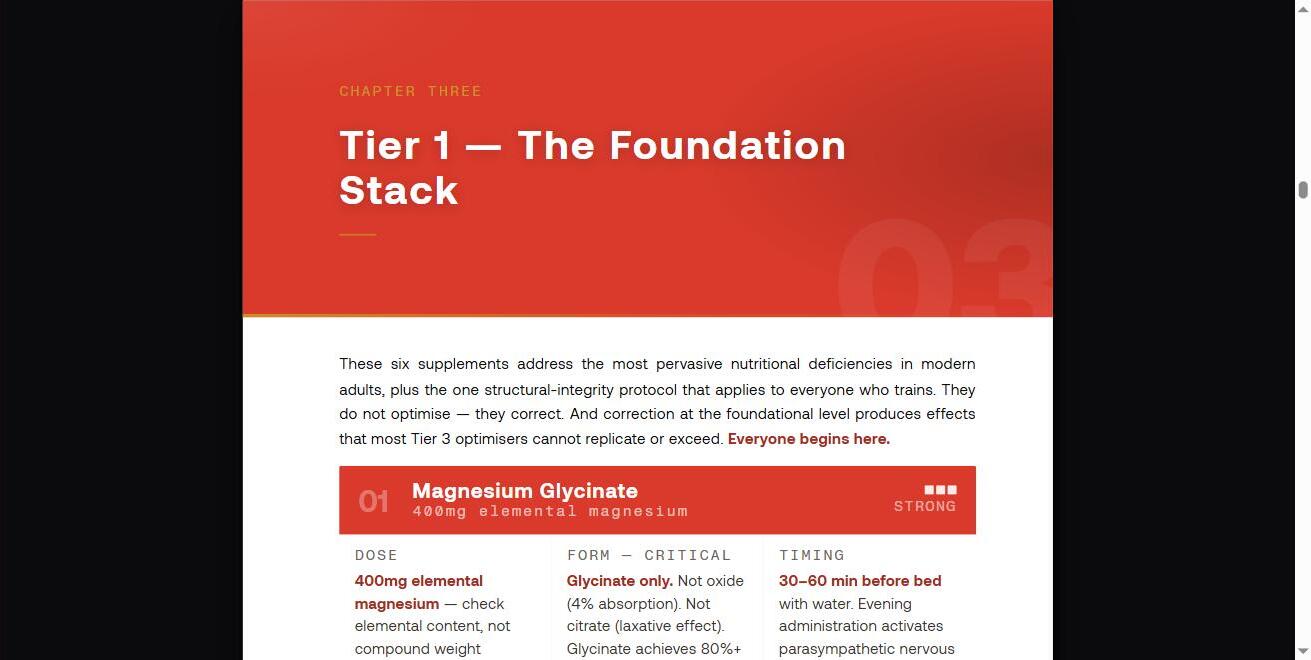
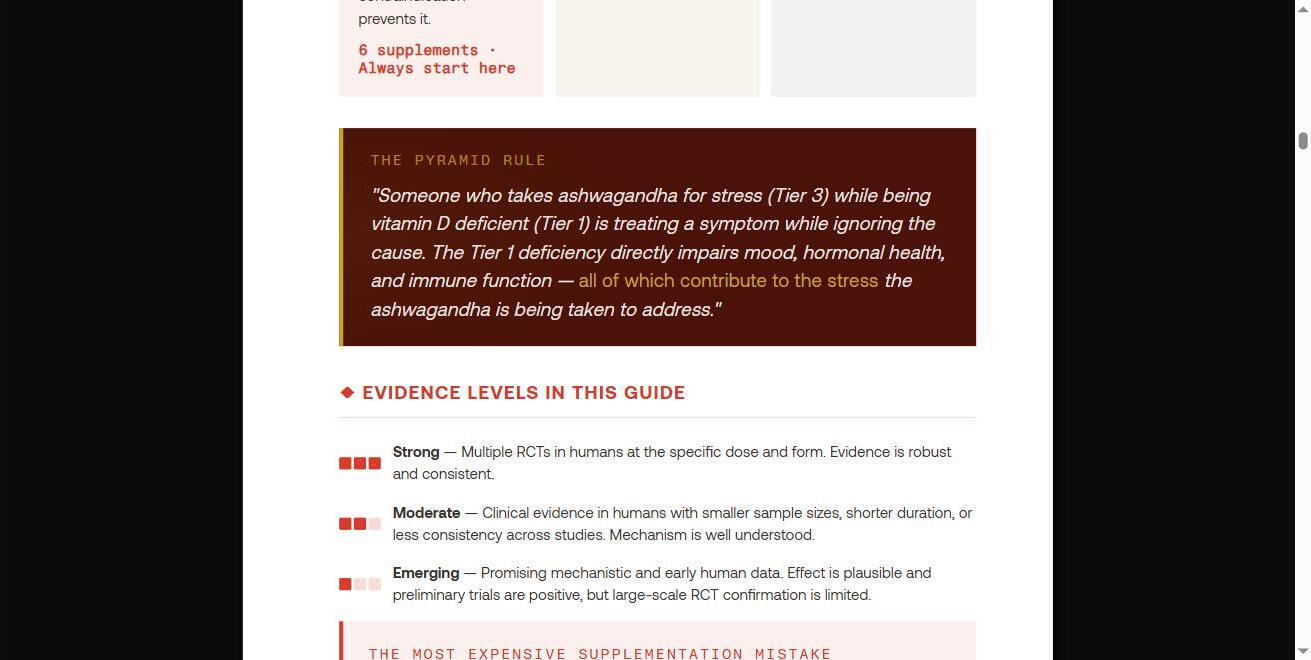
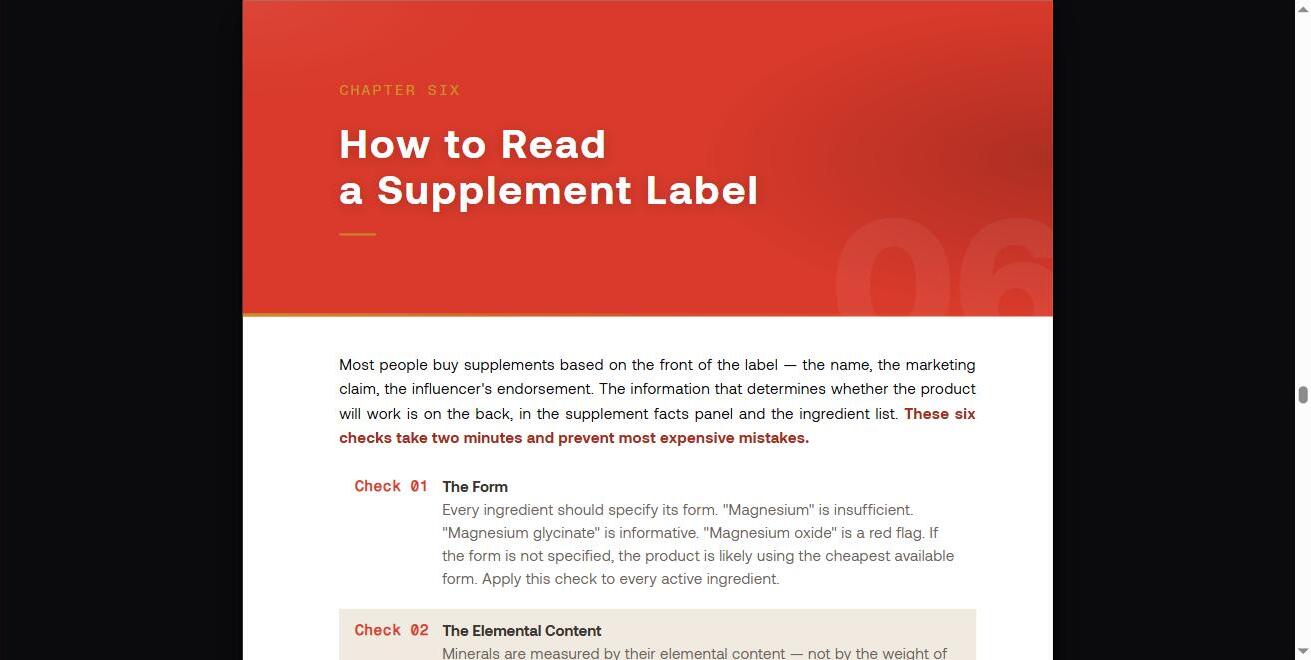
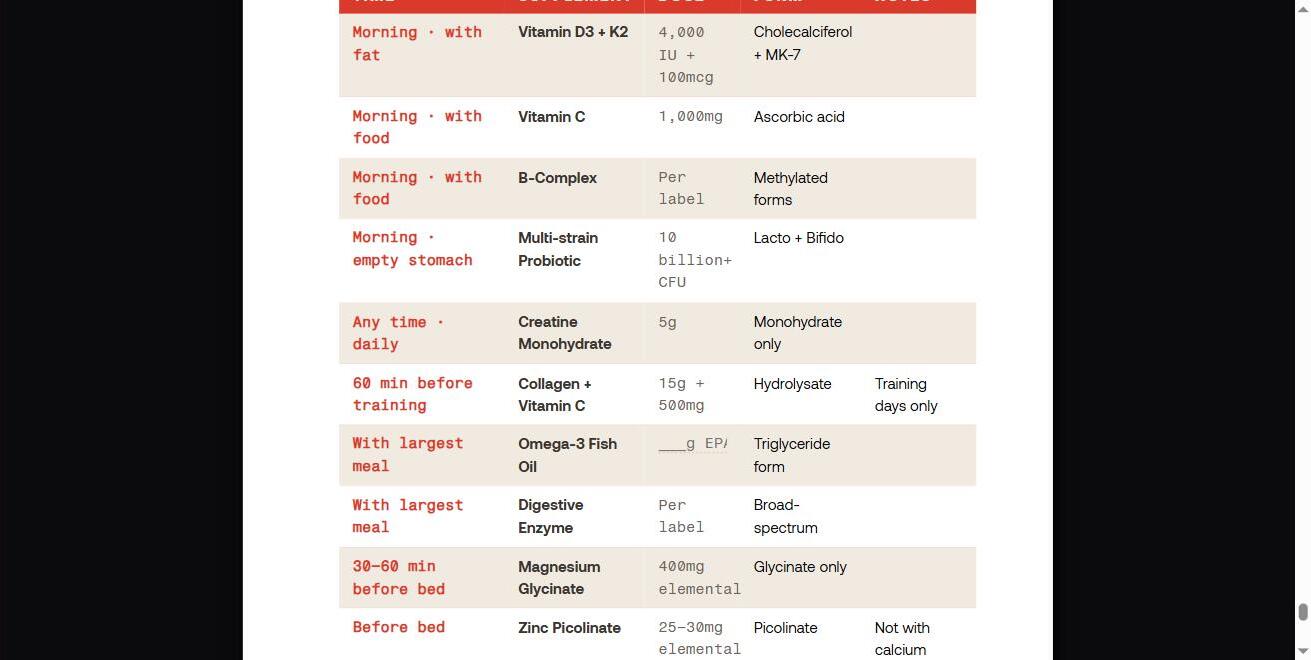
This is what actually opens after checkout, not a mockup: the real sidebar, tier navigation, and protocol card.
Not renders, not stock mockups — these are screenshots of the real product, exactly as it looks on your screen.


Actual screenshots from the interactive guide — this is exactly what you'll see.
Every recommendation in this guide traces back to the same four-criteria evaluation, not a generic "top 10" list built for a reader who isn't you.
Evidence quality, individual applicability, form specificity, and timing precision. Every supplement in this guide is run through all four before it earns a recommendation.
What you take first changes everything. Tier 1 foundation, Tier 2 additions, Tier 3 optimisers, added strictly in that order, never the reverse.
Sixteen supplements, every one specified down to the chemical form and the elemental dose, so a label can't quietly substitute the cheap version for the one that actually absorbs.
How to spot a proprietary blend, form obfuscation, and sub-threshold dosing yourself, plus the Daily Protocol Card that closes the loop on your actual stack.
"Someone who takes ashwagandha for stress while being vitamin D deficient is treating a symptom while ignoring the cause." Tier 3 optimisers don't fix a Tier 1 gap. They just cost more.
Two supplements can share the same name on the label and behave nothing alike in your body. The cheap form and the effective form are rarely the one you'd guess, and most people have never checked which one they own.
Some supplements need to be taken with food. Some need a specific window around training. Some do nothing at all if you take them at the wrong time of day. The when is part of the dose, and most labels don't mention it.
"Adding optimisers on top of deficiency is the most expensive mistake in supplementation." The order you add supplements in matters as much as which ones you choose.
Not adjectives we wrote about ourselves. Real reactions from people who audited their own shelf against the framework.
"I'd been taking ashwagandha every morning for almost a year because a friend swore by it for stress. Turns out I was also vitamin D deficient the whole time and had no idea. The Pyramid Rule section was the first time anything explained why the ashwagandha never seemed to be doing much."
"I checked the bottle after reading the form-specificity chapter and, sure enough, magnesium oxide. Switched to glycinate and noticed the difference with my sleep within about two weeks. I'd been taking the wrong version of the same supplement for three years."
"I've started and quit a supplement stack probably four times because I'd lose track of what I was even taking. Filling in the Daily Protocol Card and sticking it to my cabinet is the first time I've actually kept a stack consistent for more than a month."
"Chapter 8 told me to skip a pre-workout I'd been buying monthly because the actual active ingredients were dosed under the effective threshold. That's real money back in my pocket every month, not just a chapter I read once."
Three tiers, sixteen supplements, one order to add them in.
I want a stack that's actually working for me, not against me — $29Eight chapters. The Three-Tier Framework. All sixteen supplements, forms and doses included. The Daily Protocol Card. Add up what that's worth to you, then look at the number below it.
Open it, run through your own shelf against the framework, read as much or as little as you want. If you don't think it's worth more than $29 within 14 days, email us and we'll refund you in full. Just tell us it wasn't worth it and we'll process the refund the same day. We built this to be used, and that means the risk sits with us, not you.
Here are the honest answers to what's probably still on your mind.
No. The Three-Tier Framework exists specifically so you can audit what you already own rather than replace it wholesale. Chapter 6 shows you how to check your current bottles against the form and dose standards in Chapters 3 through 5. Some of what's on your shelf will likely already clear the bar. What doesn't, you'll know exactly why, and what to switch it for.
Yes. Tier 1, the non-negotiable foundation stack, isn't goal-specific. It addresses the deficiencies that affect general health regardless of what you're training for. Tier 3 is where goal-specific optimisers come in, and the guide is explicit that those come last, not first.
No, and Chapter 2's Pyramid Rule says so directly: buying Tier 3 before Tier 1 is called out as the most expensive mistake in supplementation. The framework is built to be added to gradually, tier by tier, starting with whichever Tier 1 gaps apply to you.
Chapter 7, Safety, Interactions & Medical, exists specifically for this. It flags the interactions and contraindications worth raising with a doctor before starting anything in this guide, including situations like statin use and CoQ10 depletion. This guide is a framework for evaluating supplements, not a replacement for your own physician's judgment about your specific medications.
The market profits from your confusion. The framework removes it, in the time it takes to read eight chapters.
I want to know my stack is actually working — $29If you've read all the way down here, I'll be direct with you, because you've earned that much. You already know whether your current shelf is a considered stack or a collection of things you bought because someone told you to. The guide is $29, less than most of the bottles already sitting in your cabinet. Run your own stack through the framework tonight. Find out which four are actually working. Then decide what the other twelve are for.