Not a vibe. Not "looking fit." An actual ratio, 1.618 to 1, first documented by the Greek sculptor Polyclitus twenty-five hundred years ago and quietly confirmed by evolutionary psychology ever since. Give me your measurements and the next few minutes, and you'll know your exact number, whether you're closing a shoulder-to-waist gap or a waist-to-hip one, and exactly what closes it.
Let me guess what your training actually looks like.
More weight on the bar. More sets. A bulk phase that becomes a permanent lifestyle because cutting feels like giving up progress. Somewhere in there, your waist grew right alongside your shoulders, and nobody flagged it, because "bigger" was the only metric on the table. Here's the part that should sting a little: pure mass isn't the standard. It never was. Bodybuilding chasing maximum size actually violates the ratio, because a thickening waist drags the number down even as the scale goes up.
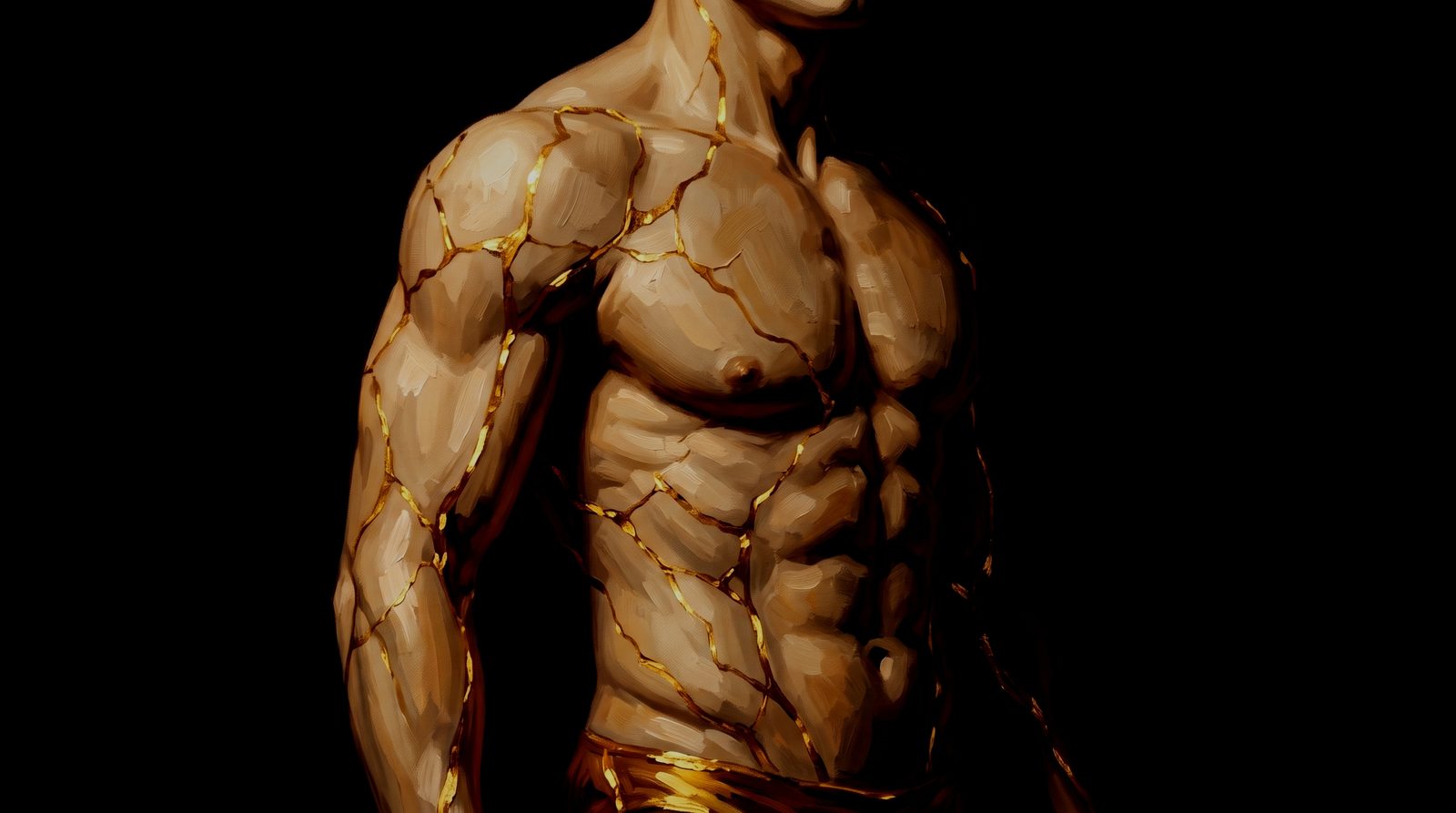
Polyclitus didn't write the Canon to describe the biggest body in Athens. He wrote it to describe the most correctly proportioned one, and then built the Doryphoros to prove the math held up in stone. Shoulder circumference divided by waist circumference, 1.618 to 1. That number shows up in a nautilus shell, in the branching of a tree, in the human face, and in the specific relationship between two measurements you can take with a tape measure tonight.
Here's the part that actually matters, if you'll let me say it plainly: this isn't only about how you look with your shirt off. Waist circumference is one of the most replicated predictors of cardiovascular disease and metabolic syndrome in the research, in some studies a better predictor than BMI alone, because it captures visceral fat directly instead of guessing at it. Closing your ratio gap isn't vanity. It's also the most direct health metric you're not tracking.
And if your body has never been a shoulder-dominant story, that's not a footnote here. Waist-to-hip, target around 0.70, is an equally real, equally researched half of this system. Keep reading. The next section shows you exactly where your number sits right now, and what closes the gap.
Not four disconnected fitness topics. One measurement-to-protocol system, where each piece tells you what the last one meant.
Most sales pages describe a book in adjectives. Here's the actual table of contents.
$29. Every chapter above, included.
I want to know my exact number, $29Be honest, you've bought a fitness PDF before. You know exactly how that story ends: downloaded once, opened twice, buried three folders deep by week three. We built this one specifically so that doesn't happen to you again.
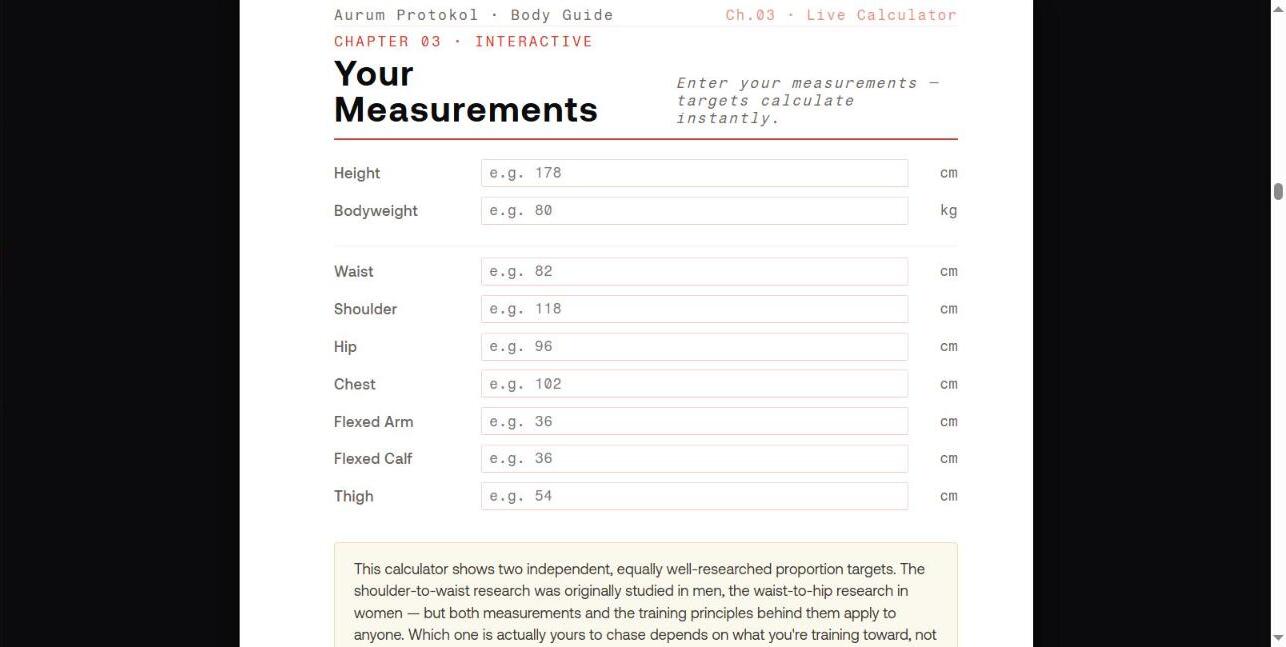
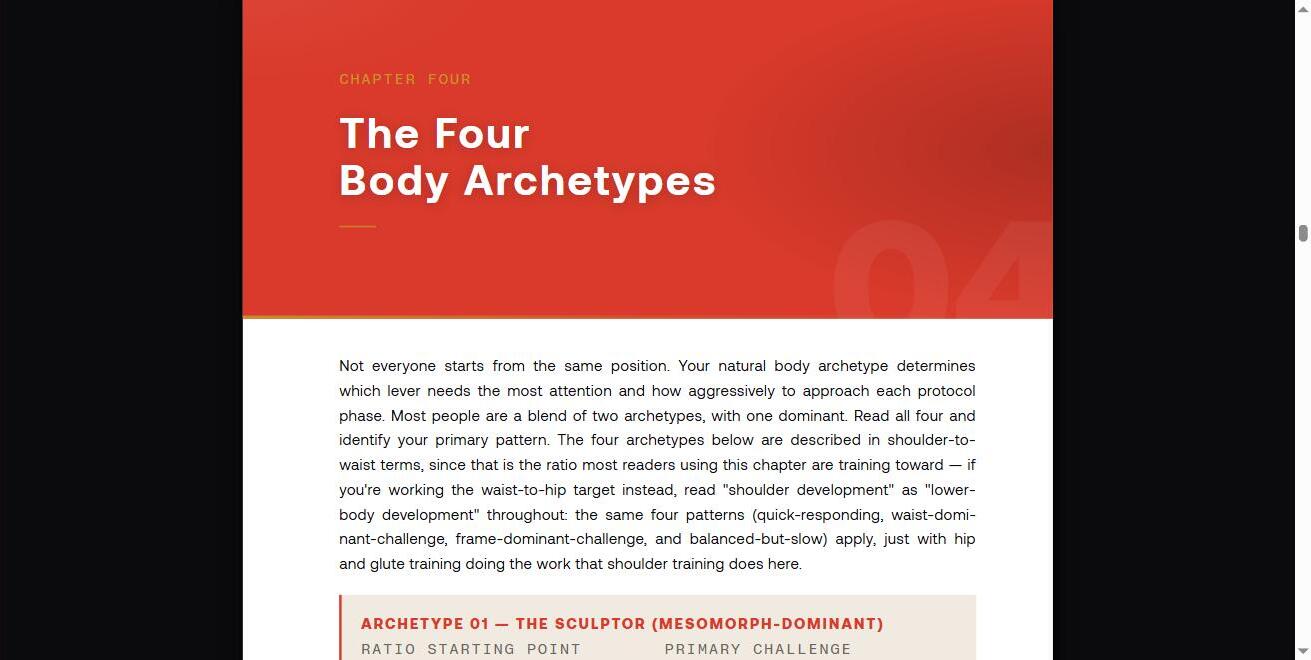
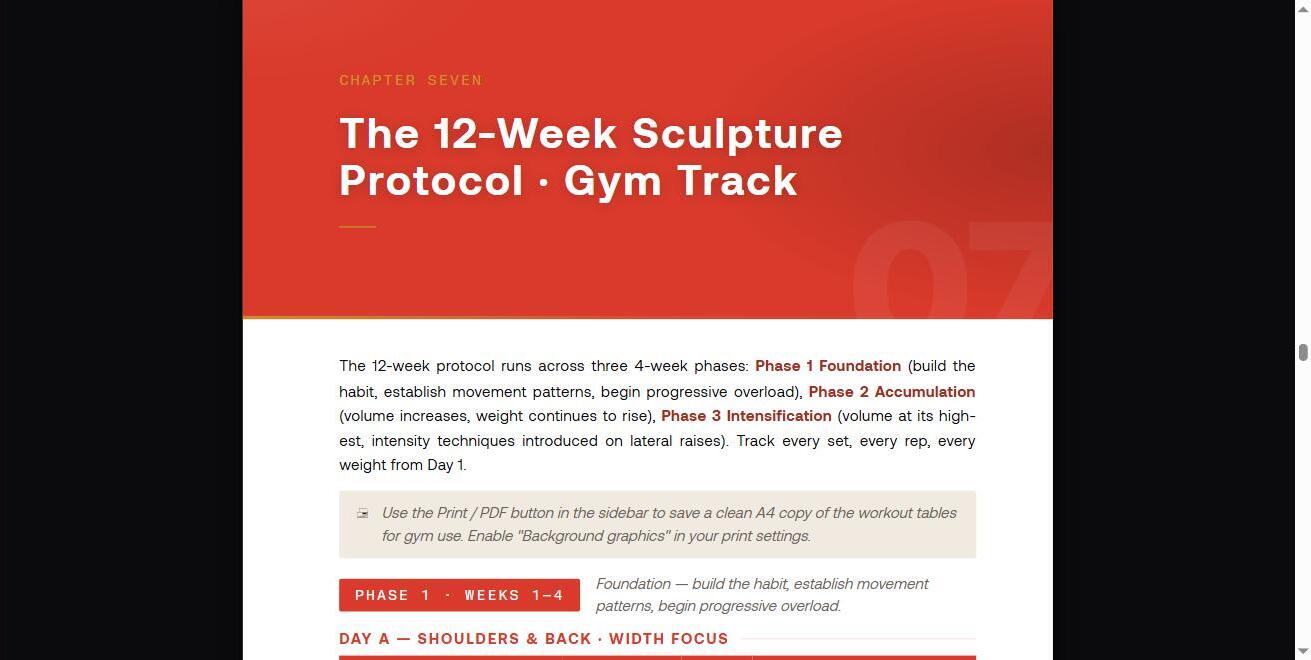
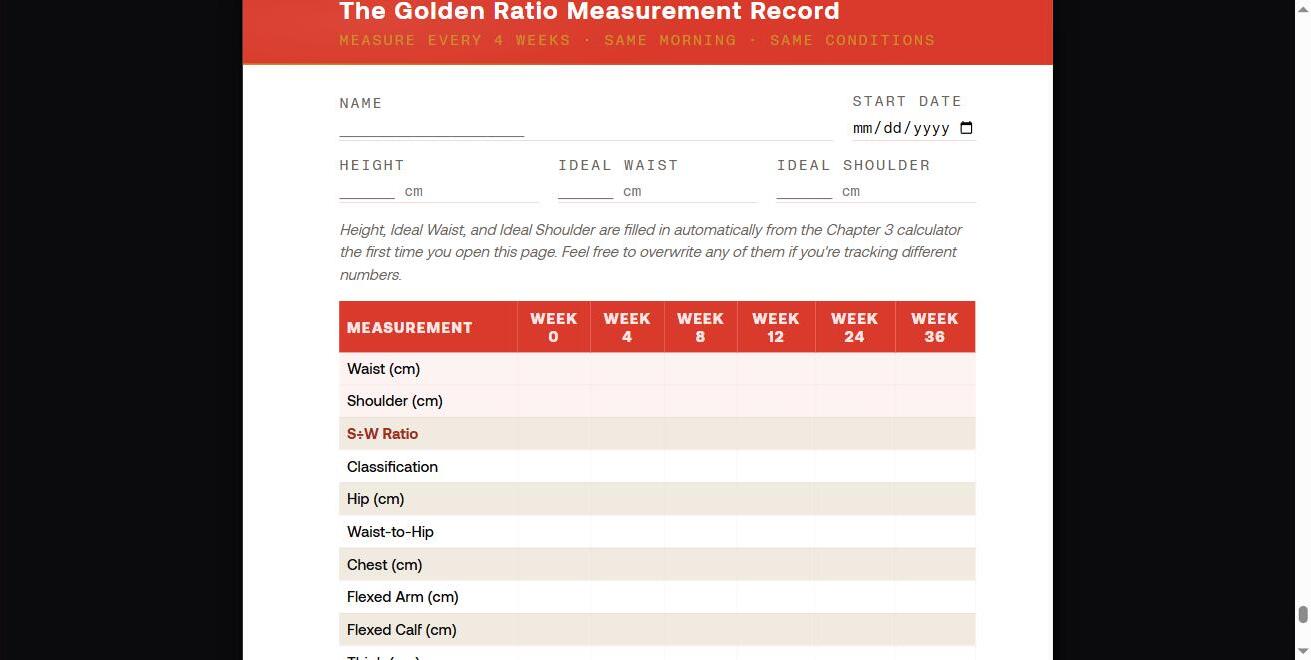
This is what actually opens after checkout, not a mockup: the real sidebar, calculator, and progress tracker.
Not renders, not stock mockups: these are screenshots of the real product, exactly as it looks on your screen.


Actual screenshots from the interactive guide: this is exactly what you'll see.
Every recommendation in this guide traces back to your actual numbers, not a generic template built for a reader who isn't you.
Nine measurements in, both ratios out, instantly, with a tier classification so you know exactly where you stand before you train a single set.
Your natural starting point changes your strategy, not your target. The guide identifies four distinct starting points, each with its own distinct approach, so you're never following a plan built for someone else's body.
Three structured phases, with a full Gym Track and a full Home Track so equipment access never decides the outcome.
Calorie targets by goal and body fat percentage, the Protein & Collagen Protocol, the photography standard, and the printable tracker that closes the loop every four weeks.
The ratio pursues the appearance of dominance, athleticism, and health, at any age, clothed or not. Bodybuilding pursuing maximum mass actually violates it, thickening the waist past the point the numerator can outrun.
"The shoulders are built in the gym. The waist is managed in the kitchen. They are separate levers, and the ratio is moved by working both simultaneously." Neither one alone gets you there.
Waist circumference is one of the most replicated predictors of cardiovascular disease and all-cause mortality in the epidemiological research, in some analyses outperforming BMI, because it captures visceral fat directly.
Every archetype in this guide aims at the same ratio in the end. Where you start determines the route, never the destination.
Not adjectives we wrote about ourselves. Real reactions from people who ran the calculator and trained against their own number.
"I plugged my measurements in expecting some vague 'you're doing great' message. Instead I got an actual ratio, 1.44, and a label: Developing. First time a fitness product ever told me a real number instead of a vibe."
"No gym membership, no problem, apparently. The Home Track used my dumbbells and a pull-up bar I already owned and still hit every priority muscle group from Chapter 5. I didn't expect that."
"I'm a Chisel through and through, always been the guy who can't put on shoulder mass no matter what. Reading that my strategy needed a surplus, not more cardio, was the opposite of every generic plan I'd tried before."
"I went in for the waist-to-hip side, not the shoulder stuff, and the guide treated that as completely normal, not an afterthought. Chapter 2 explained the research was different, not that my target was less important."
Four archetypes, two valid targets, one 12-week protocol.
I want shoulders and a waist that are actually working together, $29Twelve chapters. The Live Calculator. Your archetype. A 12-week protocol built for whichever equipment you actually have. Add up what that's worth to you, then look at the number below it.
Open it, run the calculator, read as much or as little as you want. If you don't think it's worth more than $29 within 14 days, email us and we'll refund you in full. Just tell us it wasn't worth it and we'll process the refund the same day. We built this to be used, and that means the risk sits with us, not you.
Here are the honest answers to what's probably still on your mind.
No. The Four Archetypes chapter exists specifically because most people aren't starting from the same place. Each archetype covers a different starting range and a different priority, whether that's waist reduction first or a caloric surplus instead of a deficit. Wherever your number lands, there's a real strategy built for that starting point, not a "get lean first" gate before the guide applies to you.
Yes, fully. Waist-to-hip, target around 0.70, is covered in complete detail alongside shoulder-to-waist, not as a smaller side note. The calculator shows you both numbers and lets you pick your focus. Which target is actually yours depends on your own proportions and goals, not your sex, and the guide says so directly.
No. The Home Track hits the same priorities as the Gym Track, lateral deltoid and upper back development, managed waist, compound movements first, using a short, specific equipment list you likely already own or can pick up cheaply, plus a small patch of floor space. Same target, different tools.
Then stop and take that seriously, and the guide says this directly too: the measuring and photo tracking is a tool for progress, not a verdict on your worth. If a numeric target starts to feel compulsive or distressing rather than useful, that's a signal to step back and talk to a professional, not a signal to measure more often.
Polyclitus proved the math in stone. The calculator proves it on you, in the next few minutes.
I want to look like this at 55, not just 25, $29If you've read all the way down here, I'll be direct with you, because you've earned that much. You already know whether your last twelve months of training moved a real number or just moved the scale. The guide is $29. That's less than one session with almost anyone qualified to help you with any single piece of this, and it comes with the actual formula, not a guess. Enter your measurements tonight. Know your number. Then go move it.