Heart Deep Dive

Somebody forgot to tell you
feelings aren't the problem.

You've optimised your training, your focus, your sleep. Nobody sat you down and explained that the quality of your closest relationships is a health variable in its own right, one the Harvard Study of Adult Development found predicts late-life health and happiness better than diet or exercise at midlife. Read the next four minutes and you'll know exactly why that's been quietly left off every plan you've ever followed.

4 dimensions · 1 operating system
Keep reading
A confession, before we go any further

You haven't been too emotional. You've been managing feelings you were never taught to read accurately.

Let me guess how you actually deal with a bad feeling.

You push through it, mostly. Name it "stress" or "a rough week" and keep moving, because there's a job to do and feelings are, generally speaking, not it. If something's still bothering you three days later, you tell yourself to let it go. If you've filed all of that under "I just need to toughen up," here's the part nobody told you: suppressing an emotion doesn't make it inert. It makes it undiagnosed.

The training program you follow has no idea what unprocessed frustration is doing to your cortisol, or what chronically elevated cortisol is doing to the recovery it's trying to build. The productivity system doesn't know that loneliness produces measurable inflammatory vulnerability, the kind researchers have compared to the health cost of smoking. Nobody selling you a better morning routine has asked what happens in your body every time you swallow something you actually needed to say.

Here's the part that actually stings, if you'll let me say it plainly: you've probably told yourself for years that you're "not really a feelings person," as if that were a personality trait instead of a skill nobody taught you. And the cost of that gap hasn't been invisible. It's been showing up in your body the entire time.

Try this one on for size. The Harvard Study of Adult Development followed hundreds of people for over 80 years, tracking everything from cholesterol to career success. The single strongest predictor of who was healthy and happy at 80 wasn't diet, wasn't exercise, wasn't even genetics. It was the quality of their close relationships at 50. Not having a partner specifically, having people they could actually be honest with.

That's not a personality problem. That's not a genetics problem. It's a skill gap, in the one pillar that gets treated as optional right up until the year it isn't, and it's exactly why "handling it privately" hasn't made it go away.

Keep reading. The next number I'm going to show you is the one that explains why the emotion you never name costs you more than the one you do, whether anyone ever told you that or not.

3
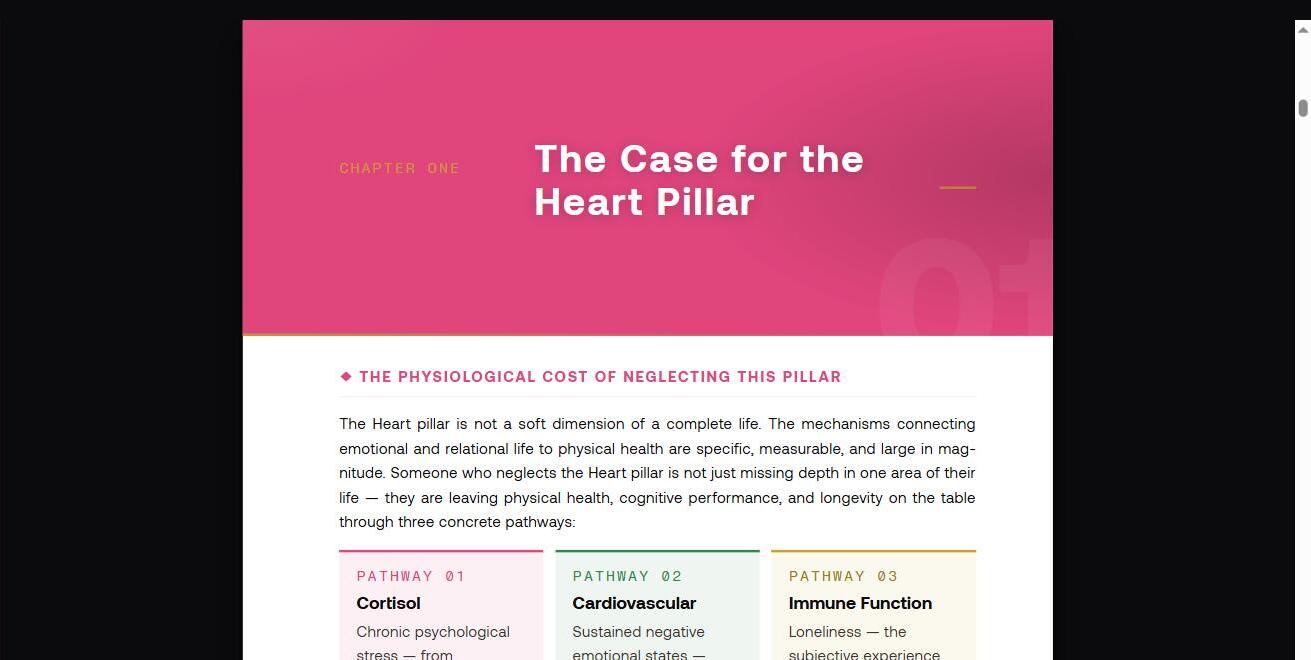
measurable physiological pathways connecting unprocessed emotion to your physical health: cortisol activation, cardiovascular strain, and immune suppression. Not metaphor, mechanism.
4
dimensions most people manage as unrelated problems (emotional wellbeing, relationships, resilience, and emotional patterns) unified here as one system.
4
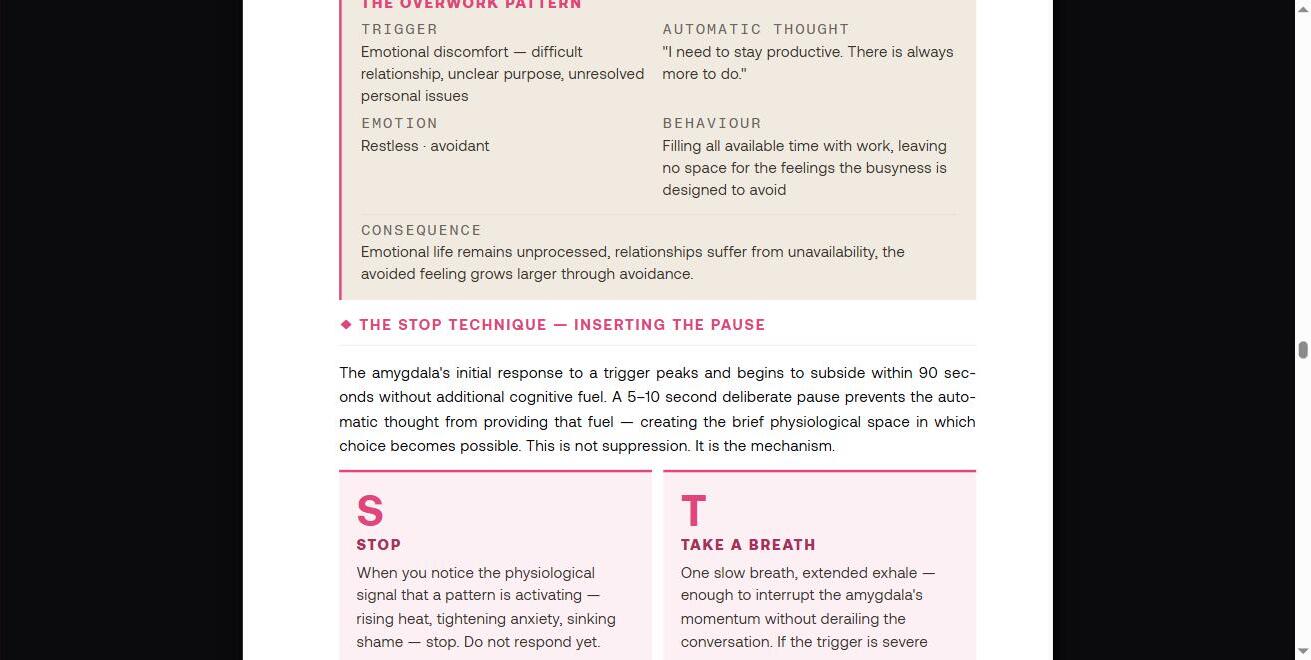
letters in the STOP technique, a short pause inserted between trigger and reaction, long enough for the initial amygdala activation to subside and the rest of the brain to participate in the decision.
What's actually inside

All 4 dimensions. One system.

Not four separate self-help topics stapled together. Four layers of the same system, each one shaping how the other three actually perform.

Emotional wellbeing icon
Emotional WellbeingWhy affect labelling, naming a feeling precisely instead of vaguely, measurably reduces the brain's stress response, and the four regulation techniques matched to different situations.
Relationships and connection icon
Relationships & ConnectionThe three trainable skills behind every strong relationship, active listening, expressed appreciation, and repair, plus what a real boundary sounds like when you're not just building a wall.
Resilience and self-compassion icon
Resilience & Self-CompassionWhy resilience isn't toughness, and the five-step reframing method for finding the more complete interpretation of a setback instead of just the most positive one.
Emotional patterns icon
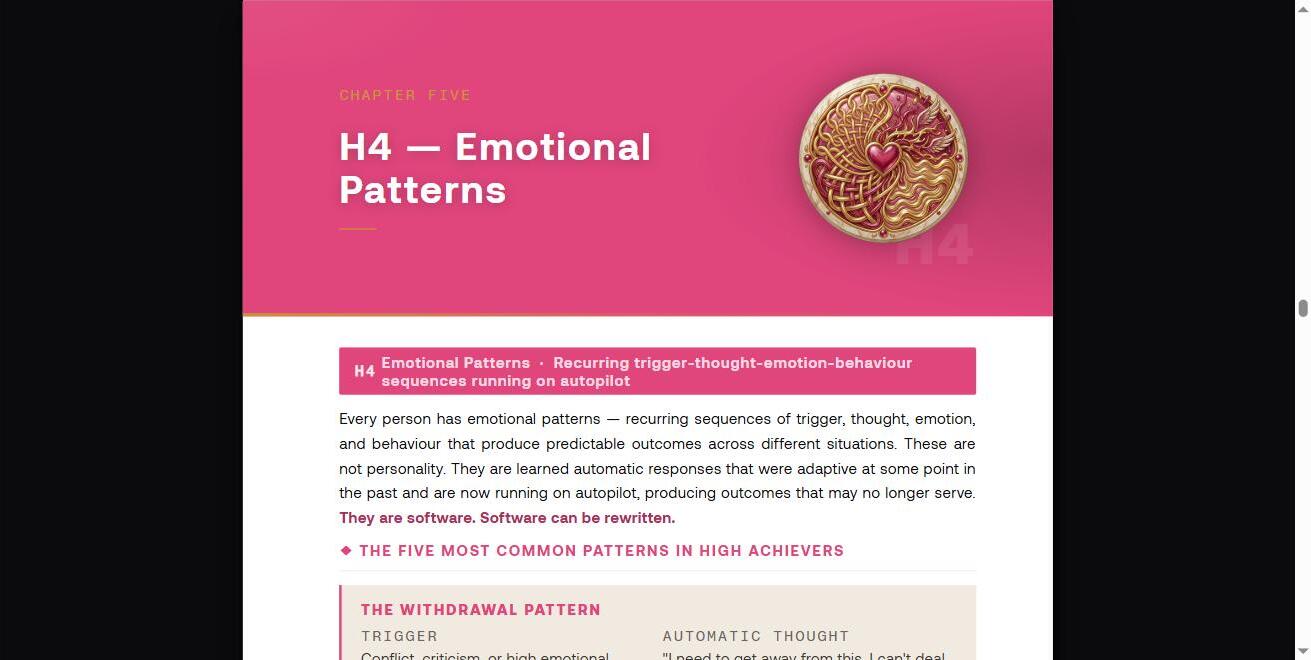
Emotional PatternsHow to map the trigger-thought-emotion-behaviour loop you keep repeating, and the STOP technique that inserts real choice into the middle of it.
Who built this, and why it's not another trend

Over a year in the making. Tested before it was ever sold.

Aurum Protokol didn't start as a product. It started as a question: what would it look like if someone actually connected the dots most guides leave separate? A year of research, writing, and revision later, here's what makes this different from the next thing in your feed.

01

Built over a year, not a weekend

This isn't a PDF someone assembled from other people's blog posts in a week to catch a trend. Every subsection went through multiple rounds of research and revision before it was considered finished.

02

Tested on real readers before launch

Before this was ever for sale, it was read cover to cover by a group of real people who used it against their own relationships and reactions. Their feedback shaped what stayed, what got cut, and what got rewritten.

03

Science-based, not trend-based

No fads, no "just trust your feelings." Every principle is checked against actual research and mechanism, including the Harvard Study of Adult Development, the kind of evidence that still holds up five years from now, not five weeks.

04

The most skipped pillar, not the least important

Heart is one of Four Pillars (Body, Mind, Heart, Spirit), and the one most people quietly avoid, because it's harder to measure than a rep count. Built to work standalone or as the layer that makes the other three sustainable.

We'd rather under-promise and let the content do the convincing than oversell you on hype we can't back up. If a claim is in this guide, it's there because it held up, not because it sounded good on a sales page.

Exactly what you're getting

All 9 chapters. Nothing hidden until checkout.

Most sales pages describe a book in adjectives. Here's the actual table of contents.

+How to Use This GuideThe Longevity Principle, explained before you need it
01The Case for the Heart PillarThe Harvard Study finding, and the three physiological pathways from unprocessed emotion to physical health
02Emotional WellbeingAffect labelling, the four regulation techniques, and why self-compassion outperforms self-criticism
03Relationships & ConnectionActive listening, expressed appreciation, repair, and what a real boundary actually sounds like
04Resilience & Self-CompassionWhy resilience isn't toughness, and the five-step cognitive reframing method
05Emotional PatternsMapping the trigger-thought-emotion-behaviour loop, and the STOP technique that inserts real choice into the middle of it
06Root Systems & The HeartThe cross-pillar mechanics: how cortisol, sleep, and intimacy physically show up in your emotional life
07The Heart's Cross-Pillar ConnectionsHow emotional regulation feeds Body, how it feeds Mind, how it feeds Spirit, bidirectional, not metaphor
+The Aurum StandardHow everything above resolves into one standard you can actually hold yourself to
+Daily Practice & AssessmentAffect-labelling log, relationship check-in, reframe worksheet, pattern-mapping tracker


That's the whole book. Nothing held back for an upsell later.

$29. Every chapter above, included.

I want relationships that don't quietly erode, $29
Why this isn't "just another PDF"

Most digital products are a file you forget. This one you'll actually use.

Be honest, you've bought a self-help PDF before. You know exactly how that story ends: downloaded once, opened twice, buried three folders deep by week three. We built this one specifically so that doesn't happen to you again.

A typical PDF guide

Static text, no way to track which reframes or regulation techniques you've actually used
No search. Scroll and hope you find the section again
No memory of where you left off last time
Printing means losing the "living document," it's frozen the moment it's exported
Your reframes, notes, and progress live nowhere but your memory

The Heart Deep Dive (interactive guide)

Fillable, auto-saved tracker: affect-labelling log, relationship check-in, reframe worksheet, and pattern-mapping tracker save to your browser as you type or check a box. Close the tab. Come back next week. It's still there.
Live search + a progress bar: jump straight to any of the 9 chapters, and watch the bar track exactly how far through the system you've actually read.
Export & import your data: download a backup of everything you've entered, or move it to a new browser or device whenever you want.
Print or save as a clean PDF: one click gives you a paginated copy of the reframe worksheet for your desk, journal, or wherever you actually do the work.
Keyboard navigation: arrow keys move you page to page, so reading it feels like using a tool, not wrestling a file.
The Heart Deep Dive
AURUM PROTOKOL
PROGRESS34%
CONTENTS
Cover
The Case for the Heart Pillar
01 · Emotional Wellbeing
02 · Relationships & Connection
Print / PDF
Export Data
Reset Progress
AURUM PROTOKOL HEART PILLAR · EMOTIONAL SYSTEM
HEARTDEEP DIVE
ALL 4 DIMENSIONS

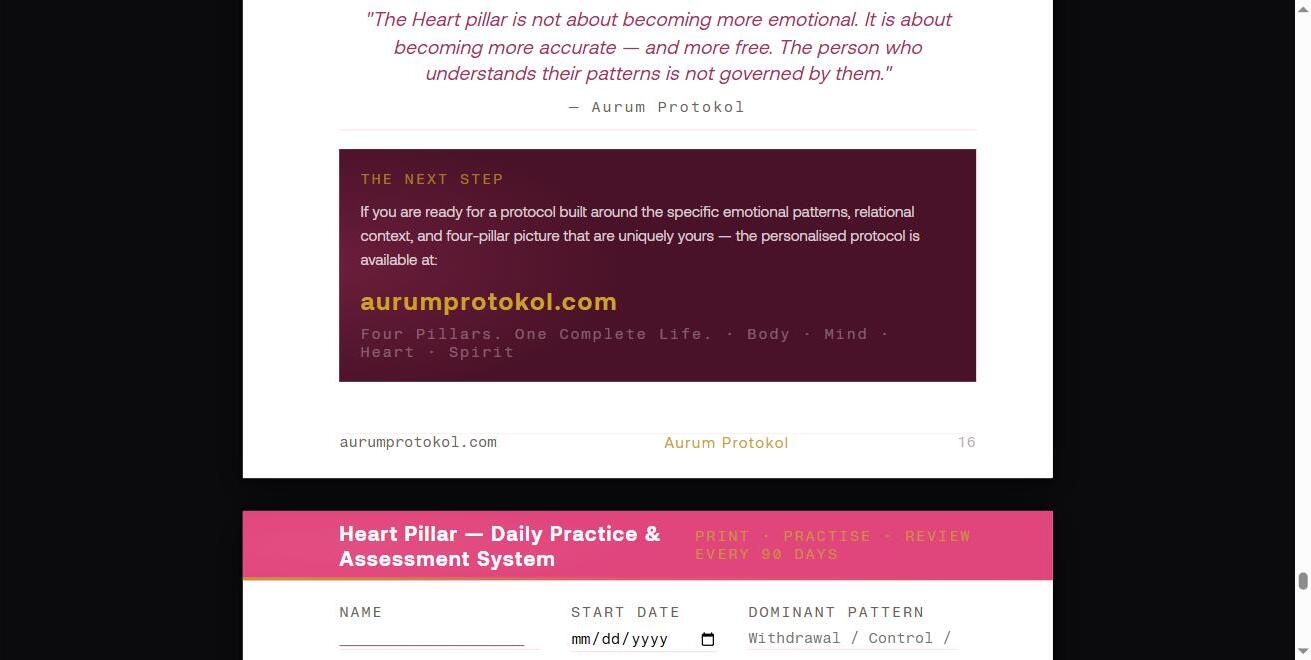
This is what actually opens after checkout, not a mockup: the real sidebar, search, and progress tracker.

The filter everything passes through

The Accuracy Principle: are you feeling this, or avoiding it?

Every recommendation in this guide is measured against four dimensions, not how to feel more, but how to read what's already there more accurately.

Emotional Wellbeing

The regulation layer: naming what you actually feel precisely enough that your nervous system can do something with the information.

In the guide: why affect labelling measurably reduces amygdala activation, and the four regulation techniques matched to different situations.

Relationships

The connection layer, not a fixed trait but a set of trainable skills that determine whether your closest relationships strengthen or quietly erode.

In the guide: why the Harvard Study of Adult Development found relationship quality outpredicts diet and exercise for late-life health.

Resilience

The recovery layer underneath everything else: the capacity to be genuinely affected by difficulty and still return to function.

In the guide: the five-step cognitive reframing method that finds the more complete interpretation of a setback, not just the most positive one.

Emotional Patterns

The software layer: the recurring trigger-thought-emotion-behaviour loops learned from past experience, which can be mapped and rewritten.

In the guide: how to map your own pattern from your last three overreactions, and the STOP technique that gives the rest of your brain time to catch up before you react.
Inside the guide

Four ideas the whole system runs on

01

Precision is the regulation technique

Affect labelling, naming an emotion specifically instead of vaguely, reduces amygdala activation on its own. The more precise the label, the greater the effect, and the guide walks through exactly how to get more precise than "I feel bad."

02

Self-compassion beats self-criticism

Self-criticism maintains the standard you're holding yourself to but prevents recovery from falling short of it. Self-compassion is the only response that does both: keeps the standard, and actually lets you get back up.

03

Toughness is brittle. Resilience isn't.

Toughness suppresses difficulty. Resilience means being fully affected by it and still returning to function. One is built through avoidance. The other is built through engagement, and it's the one that holds up under real pressure.

04

Patterns are software, not character

A recurring trigger-thought-emotion-behaviour sequence feels like "who you are" because it's automatic, not because it's fixed. It's a pattern learned from past experience, which means it can be mapped, and rewritten, over months of deliberate practice.

In readers' own words

What people actually said after reading it

Not adjectives we wrote about ourselves. Real reactions from people who read this and used it against their own relationships and reactions.

"I've done therapy, read the books, tried the apps. Nobody had ever explained why naming a feeling specifically, instead of just saying 'stressed,' actually changes how strongly it hits. I finally have a tool that works in the moment, not just in hindsight."

Melissa H., nurse

"The boundaries chapter alone was worth it. I always thought boundaries meant shutting people out. Realizing they're actually about being specific and honest changed how I talk to my own family."

Carlos V., father of 2 school-age kids

"I've read the self-compassion advice before and dismissed it as soft. The mechanism finally made sense to me: self-criticism keeps the standard but blocks recovery. That reframe alone got me through a rough quarter at work."

Renee K., sales director

"What got me was mapping my own pattern. Same trigger, same reaction, for probably a decade, and I'd never once written it down until this. Seeing it on paper was the first step in actually changing it."

Tyler B., high school teacher

That's what actually changed for people who read it.

Four ideas down. All four dimensions inside, in full.

I want to stop reacting and start responding, $29
Here's the whole offer, plainly stated

Everything above. The tool to actually use it. One price.

Nine chapters. Four dimensions. One accuracy filter running through all of it. A tracker that remembers what you've done even when you don't. Add up what that's worth to you, then look at the number below it.

Heart Deep Dive
Emotional Wellbeing, Relationships, Resilience, Patterns: one system
All 4 Heart dimensions, unified into one systemcore guide
The Case for the Heart Pillar and the three physiological pathwayscore guide
Cross-pillar Root Systems connectionsincluded
Interactive Heart Tracking System (auto-saved, exportable)included
Live search + reading progress barincluded
Print / save-as-PDF export, any timeincluded
The Aurum Standard: how it all fits togetherincluded
One-time. No subscription. Yours forever. $29
I want to feel things accurately, not just less, $29
Instant digital delivery. Opens in any browser, on any device.
The 14-Day "Actually Read It" Guarantee

Open it, use the tracker, read as much or as little as you want. If you don't think it's worth more than $29 within 14 days, email us and we'll refund you in full. Just tell us it wasn't worth it and we'll process the refund the same day. We built this to be used, and that means the risk sits with us, not you.

Part of the Four Pillars system: Body, Mind, Heart, and Spirit each stand alone, and compound when combined.

Still deciding? Fair. You've got a 14-day guarantee either way.

Here are the honest answers to what's probably still on your mind.

Before you decide

The honest answers to what you're actually wondering

"I'm not really a 'feelings' person, won't this just be more of the same self-help stuff?"

Fair question, and here's the honest answer: this isn't about becoming more emotional. It's the opposite. It's about becoming more accurate about what you already feel, so it stops leaking out sideways as irritability, distance, or a body that won't stop tensing up. If you've dismissed this pillar as soft before, that's exactly the assumption this book pushes back on.

"Is this therapy, or a replacement for it?"

Neither, and it says so directly in the emotional wellbeing chapter. These are evidence-based regulation practices for the ordinary, significant stresses of daily life, used alongside professional care, never instead of it. If you're managing something more serious, this guide will tell you clearly when to reach out to a professional instead.

"How fast will I actually notice something from this?"

Today, in the way that matters most: how precisely you can name what you're actually feeling. Affect labelling changes your nervous system's response the moment you use it, not after some 90-day program plays out. The deeper compounding, stronger relationships, more consistent resilience, builds over weeks, but you don't have to wait to start benefiting from the framework itself.

"What if it turns out this isn't for me?"

Then don't buy it, genuinely. If your emotional regulation, relationships, resilience, and self-talk are already one coordinated system for you, this won't add much you don't already have. But if you're like almost everyone else, managing these as separate problems, or not managing them at all, this was built for exactly the gap you're standing in right now. And if you buy it and change your mind, that's what the 14-day guarantee is for.

The Heart Deep Dive · $29

The pillar you can measure outlasts the one you can't.

Relationship quality predicted late-life health better than diet or exercise. The Heart pillar isn't the soft one. It's the one with eighty years of data behind it.

I want the relationships I'll still have at 80, $29
Instant digital delivery. Part of the Four Pillars system.
P.S.

If you've read all the way down here, I'll be direct with you, because you've earned that much. You already know which side of this you're on. Still telling yourself you're just "not a feelings person," or ready to see what that habit has actually been costing you and start reading your own emotional signals correctly. The guide is $29. That's less than one session with almost anyone qualified to help you with any single piece of this. It doesn't ask you to become someone more emotional. It just finally makes you more accurate.