You've optimised your training, your diet, your sleep. Every one of those is hardware. Nobody sat you down and explained that the beliefs, focus, and thinking patterns running underneath all of it are what decide whether any of it actually sticks. Read the next four minutes and you'll know exactly why that's been quietly capping everything else.
Let me guess how your last attempt at change went.
High initial motivation. Genuine early consistency. Then, at the first significant obstacle, it quietly stopped. Not a dramatic collapse, just a slow fade until the thing you were so sure would finally work joined the pile of things that didn't. If you've filed that under "I'm just not disciplined enough," here's the part nobody told you: that's rarely a discipline problem. It's a belief problem, running beneath conscious awareness, and it generates the exact behaviour it predicts.
The trainer who built your program has no idea what you actually believe about yourself under pressure. The nutrition plan doesn't know that you check your phone dozens of times a day, or that each interruption costs you real recovery time before your focus gets back to full depth. Nobody selling you a morning routine has asked what your stress response has been doing to your prefrontal cortex, the part of your brain that routine depends on to plan ahead and hold back impulses in the first place.
Here's the part that actually stings, if you'll let me say it plainly: you've probably consumed more self-improvement content than most people ever will. Books, podcasts, courses. And you can still feel the gap between what you know and what you actually do, because information was never the bottleneck.
That's not a motivation problem. That's not a genetics problem. It's an operating-system problem, and it's exactly why doing "everything right" on the physical side hasn't felt like it's adding up the way it should.
Keep reading. The next number I'm going to show you is the one that explains why a single interruption can cost over twenty minutes of real cognitive depth, whether anyone ever told you that or not.

Not four separate self-help topics stapled together. Four layers of the same system, each one shaping how the other three actually perform.
Most sales pages describe a book in adjectives. Here's the actual table of contents.
$29. Every chapter above, included.
I want to trust my own thinking again, $29Be honest, you've bought a self-help PDF before. You know exactly how that story ends: downloaded once, opened twice, buried three folders deep by week three. We built this one specifically so that doesn't happen to you again.
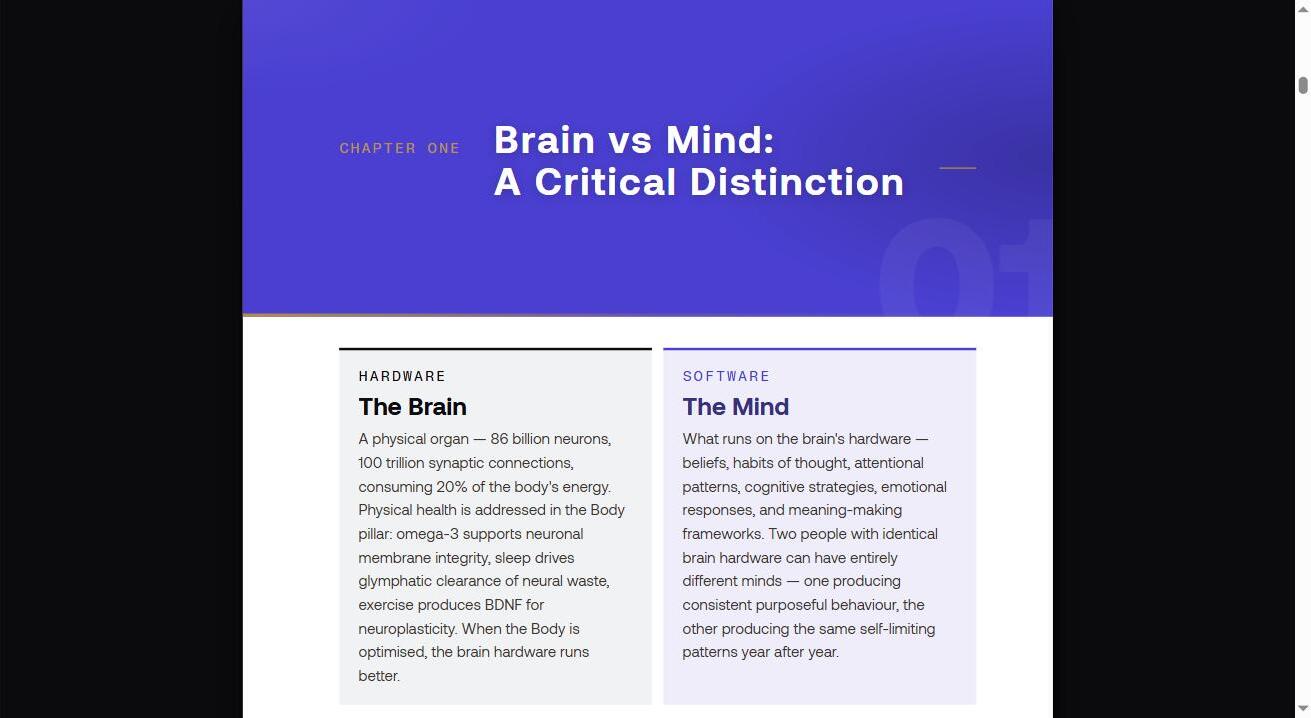
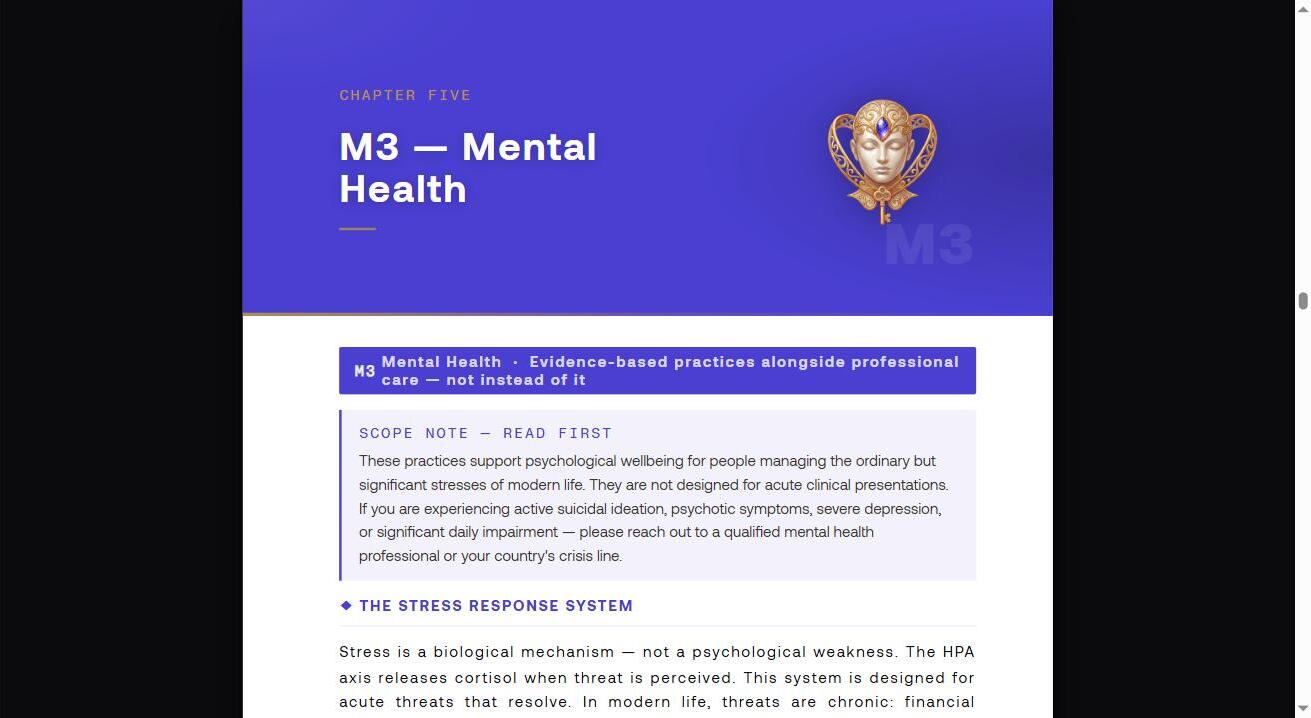
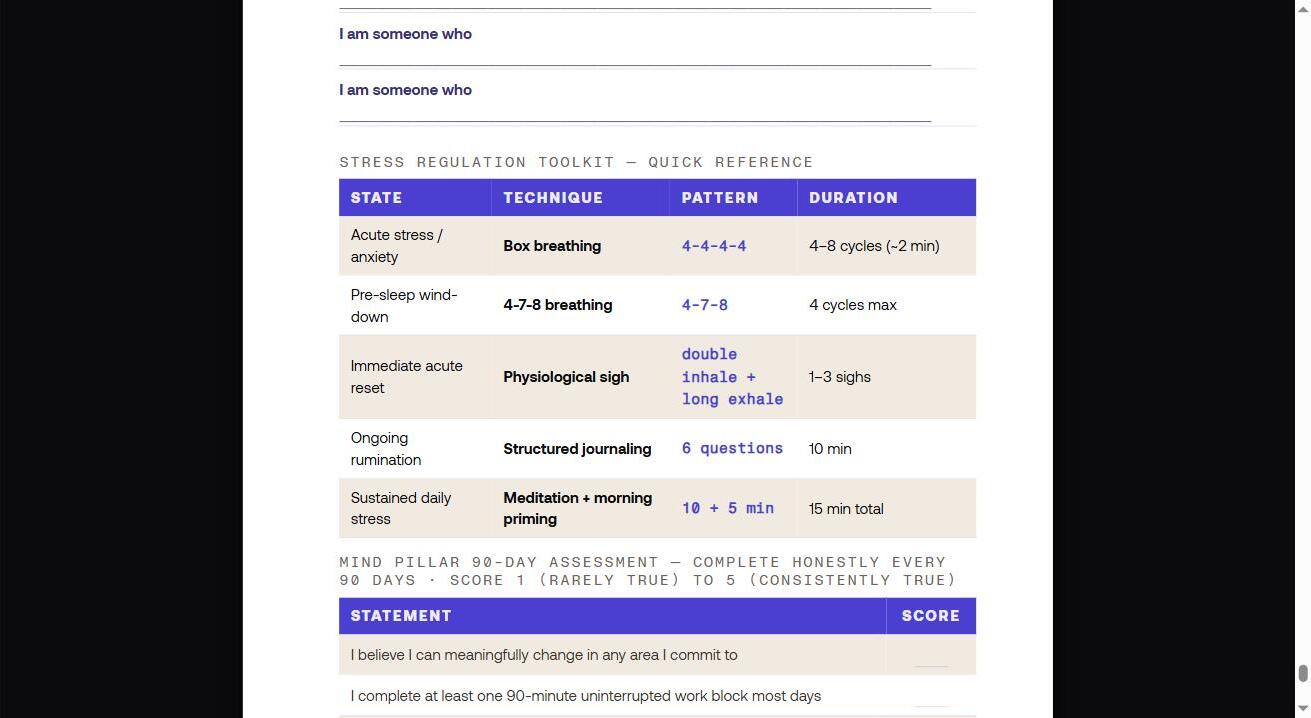
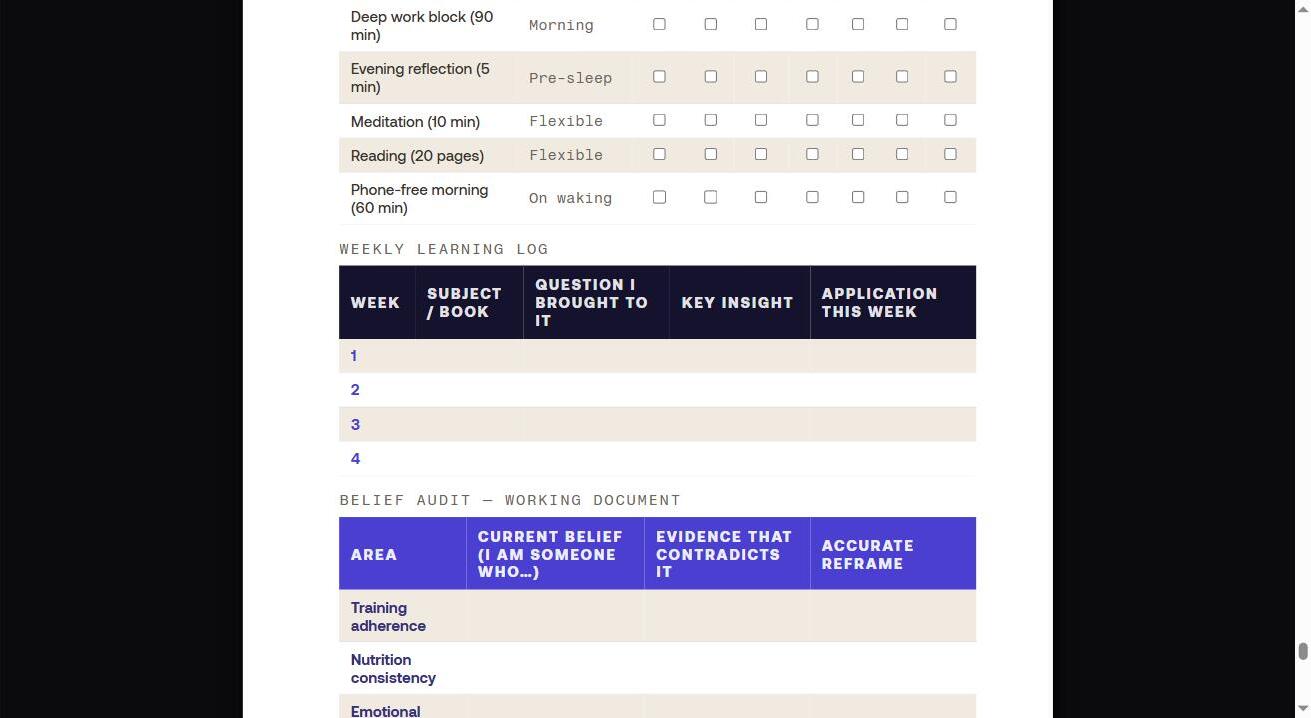
This is what actually opens after checkout, not a mockup: the real sidebar, search, and progress tracker.
Not renders, not stock mockups: these are screenshots of the real product, exactly as it looks on your screen.
Actual screenshots from the interactive guide: this is exactly what you'll see.
Every recommendation in this guide is measured against four dimensions, not just what you know, but what's actually running underneath it.
The source code: the identity-level assumptions that generate your behaviour before you consciously decide anything.
The quality of thinking actually available to you today, not a fixed trait but a daily variable shaped by five specific inputs.
The nervous-system layer underneath everything else, evidence-based regulation practices, used alongside professional care.
Progressive overload for the brain, the system that turns information you consume into capability you actually keep.
Neuroplasticity, the brain's capacity to form new neural pathways throughout life, is the biological evidence that "I'm not a disciplined person" is a description of current neurological state, not a permanent sentence.
The real cost of checking your phone isn't the few seconds you spend on it. It's the 20-plus minutes commonly cited to recover full depth of focus afterward. Attentional fragmentation is a learned habit, and it can be unlearned.
Every time someone shows up to do the hard thing when they don't want to, they add one vote to the evidence for who they actually are. Accumulated over weeks, that evidence rewrites the identity, not the other way around.
Information reviewed once and never revisited is 70 to 80% forgotten within a week. The fix isn't reading more. It's a specific, five-step protocol for turning what you read into what you can actually do.
Not adjectives we wrote about ourselves. Real reactions from people who read this and used it against their own thinking patterns.
"I've done therapy, read the books, tried the apps. Nobody had ever laid out the actual mechanical difference between the STOP technique and breathwork before. I finally know which one to reach for and when, instead of just guessing under pressure."
"The belief-reframe chapter alone changed how I talk to myself. I didn't need more motivation. I needed to see that what I was telling myself wasn't even accurate."
"I've read probably ten books on productivity and forgotten most of them within a month. The learning protocol in this one is the first system that actually made something stick, because it's built around retention, not just consumption."
"What got me was realizing my training and my thinking were never two separate problems. I'd blamed my inconsistency on discipline for years. It was never that."
Four ideas down. All four dimensions inside, in full.
I want to actually focus and follow through, $29Eight chapters. Four dimensions. One operating-system filter running through all of it. A tracker that remembers what you've done even when you don't. Add up what that's worth to you, then look at the number below it.
Open it, use the tracker, read as much or as little as you want. If you don't think it's worth more than $29 within 14 days, email us and we'll refund you in full. Just tell us it wasn't worth it and we'll process the refund the same day. We built this to be used, and that means the risk sits with us, not you.
Here are the honest answers to what's probably still on your mind.
Fair question, and here's the honest answer: most self-help content picks one lane, mindset, or productivity, or mental health, and stays there. This is the first one that treats those four as one connected system instead of four separate genres. If you've read the books and still feel the gap between knowing and doing, that gap is exactly what this closes.
Neither, and it says so directly in the mental health chapter. These are evidence-based practices for the ordinary, significant stresses of daily life, used alongside professional care, never instead of it. If you're managing something more serious, this guide will tell you clearly when to reach out to a professional instead.
Today, in the way that matters most: how you interpret your own setbacks. The belief-reframe method changes your self-talk the moment you use it, not after some 90-day program plays out. The deeper compounding, better focus, better retention, better regulation, builds over weeks, but you don't have to wait to start benefiting from the framework itself.
Then don't buy it, genuinely. If your mindset, focus, mental health, and learning are already one coordinated system for you, this won't add much you don't already have. But if you're like almost everyone else, managing these as four separate problems, or not managing them at all, this was built for exactly the gap you're standing in right now. And if you buy it and change your mind, that's what the 14-day guarantee is for.
The mind isn't one of four equal pillars. It's the multiplier. Neglect it, and every other pillar is capped.
I want every other pillar to stop being capped, $29If you've read all the way down here, I'll be direct with you, because you've earned that much. You already know which side of this you're on. Still blaming yourself for a discipline problem that was never really yours to fix that way, or ready to see the actual operating system underneath it and start working with it instead of against it. The guide is $29. That's less than one session with almost anyone qualified to help you with any single piece of this. It doesn't ask you to throw out what you already know. It just finally connects it into something you can use.