You've built the habits. You train, you eat with precision, you show up. And on the days when none of that feels like enough reason to keep going, you grit through it, because that's what discipline is for. Self-Determination Theory, the most tested framework in motivation research, found something most people never get told: willpower is the least durable driver you have. There's a level underneath it that doesn't run out. Read the next four minutes and you'll know exactly where it comes from.
Let me guess how most of your goals actually work.
You want the outcome. Lose the weight, hit the number, get the promotion. It gets you started, and for a while that's enough. Then progress stalls, or the goal gets hit and the drive that was supposed to carry you into the next thing quietly evaporates, because it turns out that motivation was never really about the goal. It was rented, one outcome at a time, and the rent came due the moment the outcome stopped moving.
Self-Determination Theory, tested across hundreds of studies, draws the same line every time: behaviour driven by reasons that are genuinely your own outlasts behaviour driven by an external target, and it isn't close. Outcome motivation ("I want to lose 10kg") has a ceiling built in. Identity motivation ("I am someone who trains consistently") survives longer, because it doesn't need visible progress, just self-coherence. But there's a third level underneath both of them, and almost nobody builds it on purpose.
Here's the part that actually stings, if you'll let me say it plainly: the reason you've white-knuckled your way through the same three habits for years, quitting and restarting each one, is that nobody ever handed you the thing underneath the habit. You've been trying to out-discipline a structural problem.
That's not a motivation problem. That's not a willpower problem. It's an architecture gap, in the one pillar that never shows up on a scale or a spreadsheet, and it's exactly why "just be more disciplined" has never actually worked for more than a few months at a time.
Keep reading. The next set of numbers explains what this pillar is actually built from, and why the guide most people skip is the one that makes the other three sustainable for decades instead of seasons.

Not four separate self-help topics stapled together. Four layers of the same system, each one shaping how the other three actually perform.
Most sales pages describe a book in adjectives. Here's the actual table of contents.
$29. Every chapter above, included.
I want the reason that doesn't run out, $29Be honest, you've bought a self-help PDF before. You know exactly how that story ends: downloaded once, opened twice, buried three folders deep by week three. We built this one specifically so that doesn't happen to you again.
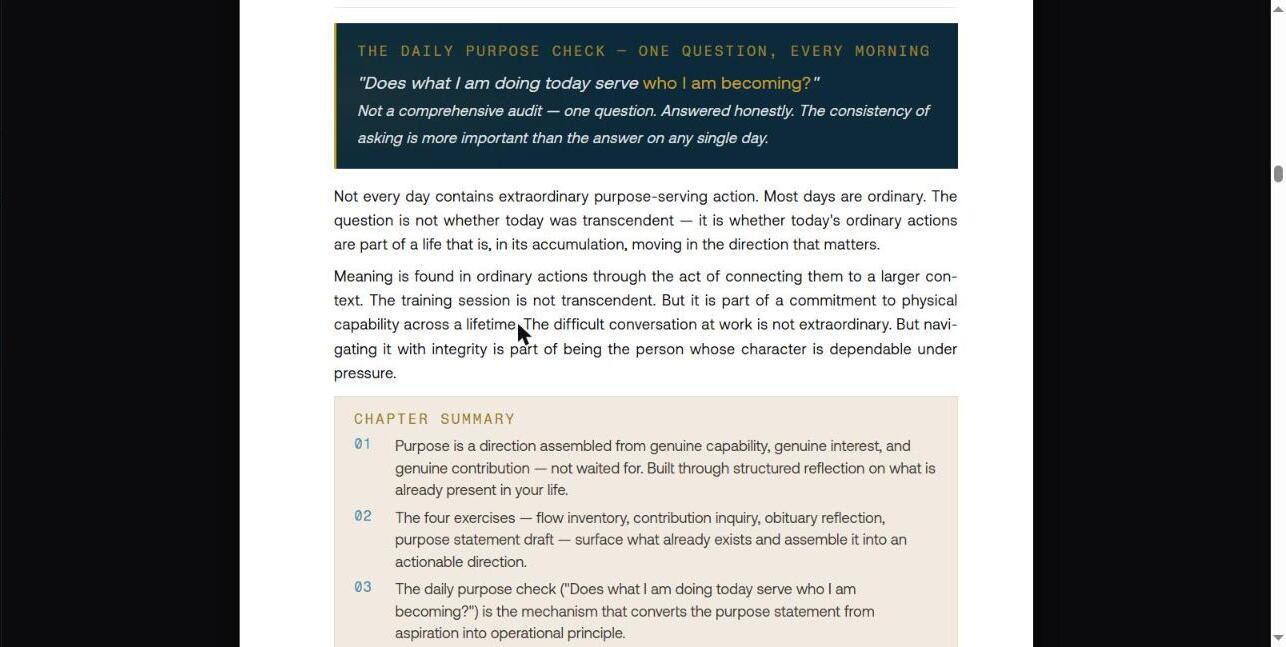
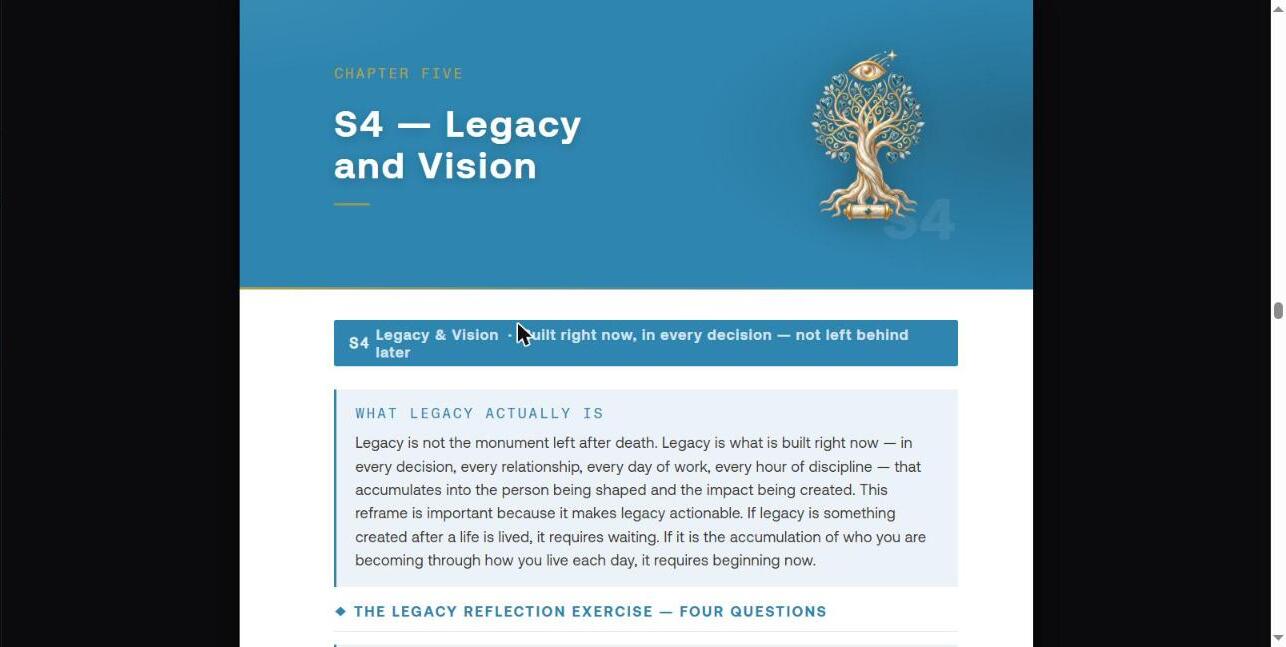
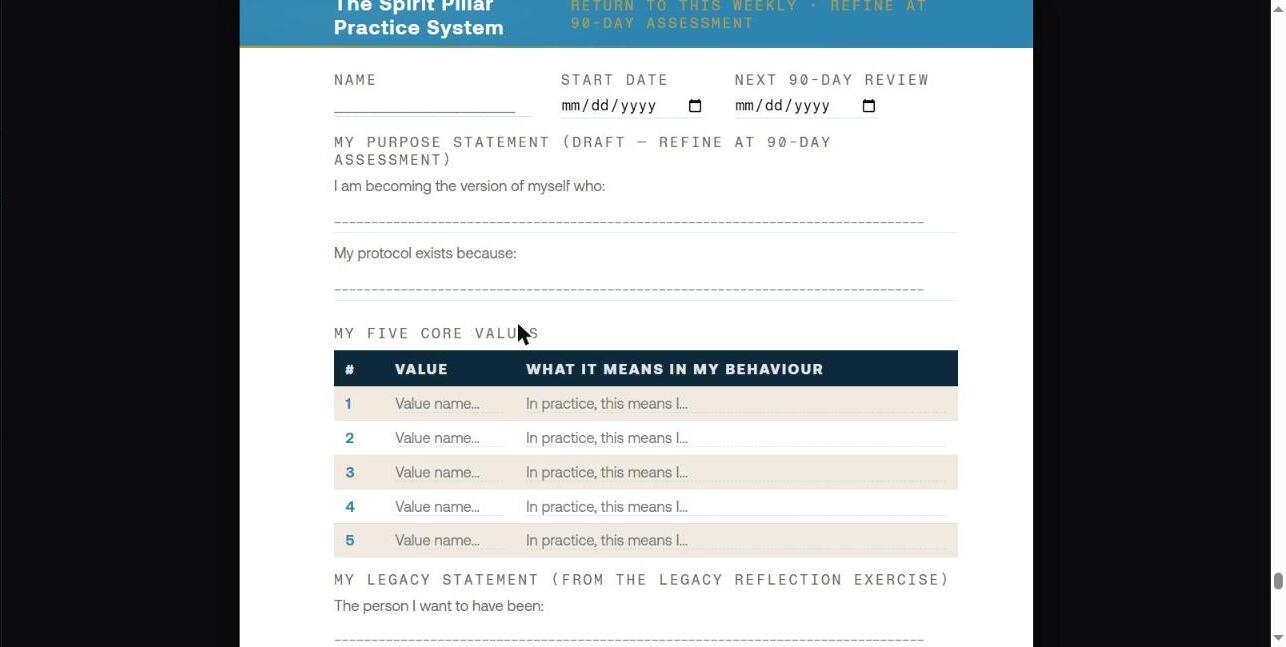
This is what actually opens after checkout, not a mockup: the real sidebar, search, and progress tracker.
Not renders, not stock mockups: these are screenshots of the real product, exactly as it looks on your screen.


Actual screenshots from the interactive guide: this is exactly what you'll see.
Every exercise in this guide is measured against four dimensions, not how to feel more inspired, but how to build a direction sturdy enough to still be standing when motivation isn't.
The direction layer: not a career or a calling, but the answer to what you're building toward and why it matters, made specific enough to act on daily.
The filter layer: the gap between the values you'd state if asked and the ones your actual choices reveal, closed one decision at a time.
The processing layer: converting passive experience into active participation in building the life, through structure, not venting.
The horizon layer: what you're building right now, in every decision, not something left behind later once a life is already finished.
Discipline forces action through willpower, and willpower has a ceiling. Commitment acts from a decision already made at a values level. The Spirit pillar's job is converting one into the other, not making effort easier, but making the reason for it more fundamental.
A purpose statement that never touches a Tuesday afternoon isn't a purpose, it's a daydream. The guide's one-question daily check is what makes it operational instead of aspirational, small enough to actually ask yourself every morning.
Unstructured venting shows little measurable benefit. A fixed set of prompts, answered honestly, is what converts journaling from mental circling into genuine processing, which is why the daily practice is a short, specific set of questions, not a blank page.
Legacy isn't a monument after death. It's the accumulation of who you're becoming through every ordinary decision, which means it requires beginning now, not waiting for a life to finish first.
Not adjectives we wrote about ourselves. Real reactions from people who read this and worked the exercises against their own actual lives.
"I've started a dozen journals and abandoned every one within a month. The difference here is the fixed set of prompts. I'm not staring at a blank page wondering what to write, I just answer them, and somehow twenty minutes on Sunday is the thing that's kept me consistent."
"The purpose statement exercise wrecked me a little, in a good way. I'd never actually written down what I was building toward, just chased whatever goal was in front of me. Having an actual sentence to check my days against changed how I plan my week."
"I almost skipped the legacy chapter because it sounded morbid. It's the opposite. Writing down the gap between who I want to have been and who I am right now was the most clarifying twenty minutes I've spent on myself in years."
"I've always been the person who quits the new habit by week three. Turns out I was running on outcome motivation the whole time, which explains a lot. Understanding the difference between that and actual purpose is the first thing that's made a habit stick past a month for me."
Four ideas down. All four dimensions inside, in full.
I want a direction that survives a bad week, $29Nine chapters. Four dimensions. One load-bearing principle running through all of it. A tracker that remembers what you've written even when you don't. Add up what that's worth to you, then look at the number below it.
Open it, use the tracker, read as much or as little as you want. If you don't think it's worth more than $29 within 14 days, email us and we'll refund you in full. Just tell us it wasn't worth it and we'll process the refund the same day. We built this to be used, and that means the risk sits with us, not you.
Here are the honest answers to what's probably still on your mind.
Fair concern, and here's the honest answer: every exercise ends in a written output, a purpose statement, a set of named values, a legacy reflection, a 10-year vision, not just a feeling of having thought about it. The daily practice is a short, fixed set of questions, not a blank journal page. If you want something you can point to and say "I did this," this guide is built around producing exactly that.
No. It's religion-neutral throughout, framed entirely around meaning, values, and inner experience, accessible regardless of philosophical or spiritual background. If you already have a spiritual practice, this tends to amplify it rather than compete with it. If you don't, none of the exercises require one.
The daily purpose check, a single question every morning, changes how you evaluate your day starting the first time you use it. The deeper work, a clarified purpose statement, a closed values gap, a real legacy direction, takes longer, spread across S1 through S4, but you're not waiting 90 days to feel the framework doing something.
Then don't buy it, genuinely. If you already have a clear purpose statement, a closed values gap, and a working reflective practice, this won't add much you don't already have. But if you're like most people, running on outcome motivation that keeps running out, this was built for exactly the gap you're standing in right now. And if you buy it and change your mind, that's what the 14-day guarantee is for.
Discipline forces action through willpower, and willpower runs out. Commitment acts from a decision already made. The Spirit pillar isn't the soft one. It's the one underneath everything else you're trying to build.
I want the version of me that doesn't quit in March, $29If you've read all the way down here, I'll be direct with you, because you've earned that much. You already know which side of this you're on. Still telling yourself the next plan, the next program, the next burst of willpower will finally be the one that sticks, or ready to build the thing underneath all of that so it stops depending on willpower at all. The guide is $29. That's less than one session with almost anyone qualified to help you with any single piece of this. It doesn't ask you to want something different. It just finally gives the wanting somewhere solid to stand.